



The first time I sat across from a mental health coach—hands wrapped around a too-hot mug, heart loud enough to drown out my thoughts—I expected a miracle. What I got instead was a simple question: “What would feeling better look like on Tuesday?” Not next year. Not a grand reinvention. Tuesday. That shift—anchoring healing to a day you can touch—was the moment things started to change. It still sounds almost absurd, and yet it works.
If you’re curious about how to make the most of a mental health coach, you’re likely craving momentum. You might be feeling stuck in stress loops, patchy sleep, or habits that don’t match the life you want. Coaching can turn intentions into steps. The trick is working the process so it reshapes your days—quietly at first, then obviously. My bias? Small moves beat grand plans.
Table of Contents
- What a Mental Health Coach Does (and Doesn’t)
- Set Goals That Actually Change Your Day
- Build a Strong Coaching Alliance
- Make Sessions Work Harder for You
- Between Sessions: Habits, Tracking, and Friction Fixing
- Common Roadblocks and How to Pivot with Your Coach
- How to Measure Progress With a Mental Health Coach
- What to Bring to Your First Three Sessions
- Safety, Ethics, and When Coaching Isn’t Enough
- Scripts You Can Borrow With Your Mental Health Coach
- How Coaching Interacts With Day-to-Day Health Inputs
- The Mindset Shift That Keeps Momentum Going
- Closing Summary and CTA
- The Bottom Line
- References
Key Takeaways
- Translate big intentions into tiny, Tuesday-ready actions with clear cues and proof.
- A strong coaching alliance—shared goals, structure, and candid feedback—drives outcomes.
- Make sessions practical: bring data, pick one target skill, and rehearse it live.
- Between sessions, track just a few metrics and fix friction, not “willpower.”
- Use coaching alongside appropriate clinical care when symptoms are severe or safety is a concern.
What a Mental Health Coach Does (and Doesn’t)
A mental health coach helps you define practical goals, build skills (stress regulation, time boundaries, reframing), and follow through. It’s action-forward and collaborative. Unlike a therapist, a coach doesn’t diagnose or treat mental disorders. If you’re navigating severe depression, trauma, or safety concerns, therapy or medical care is the right starting point. The World Health Organization estimates that around 280 million people live with depression worldwide—support is essential, and the right level of care matters (WHO). After the first pandemic year, many of us expected quick fixes; we got waitlists and fatigue instead. A coach can help you reclaim what’s controllable.
Here’s a grounded way to think about it:
- Therapy addresses symptoms and deeper patterns; coaching focuses on goals, habits, and accountability.
- Therapy uses clinical treatments like CBT to change thoughts and behaviors; coaching may borrow CBT-informed tools but stays non-clinical. CBT itself is a structured, time-limited approach with strong evidence for anxiety and depression (Mayo Clinic).
- Both rely on a strong working relationship. The American Psychological Association notes that the client–provider relationship is a central factor in outcomes across many approaches (APA).
“Coaching isn’t a shortcut around healing; it’s a pathway for turning insight into daily behavior. The right match and clear goals matter more than any single technique.”
— Dr. Laila Gomez, Clinical Psychologist
She’s right. We ask too much of willpower and too little of structure.
Set Goals That Actually Change Your Day
The fastest way to succeed with a mental health coach is to translate vague hopes into specific Tuesday behaviors. “Reduce anxiety” might become “practice 4-7-8 breathing for two minutes after lunch on weekdays” or “walk outdoors for 12 minutes before opening email.” If you can picture where you’ll stand when it happens, you’re close.
Why this works:
- Specific actions beat abstractions. The brain prefers concrete cues; when you name the time, place, and behavior, you cut decision fatigue and friction.
- Tiny wins fuel self-efficacy. Confidence grows from doing what you said you’d do, even in small amounts. That sense of agency is protective for mental health.
- Habit science favors cues and repetition. NIH’s consumer health resource emphasizes how breaking behaviors into manageable steps and using consistent triggers helps new habits stick (NIH News in Health).
Try co-creating goals with your coach using this quick blueprint:
- Anchor to a cue: After I brush my teeth…
- Make it small: I will stretch for 60 seconds…
- Attach a why: So I release tension before bed.
- Define a proof: I’ll mark it in my calendar with a check.
“A good session ends with two or three behaviors you can actually imagine doing tomorrow morning. If you can’t picture it, it’s not ready.”
— Aaron Blake, Certified Coach
I’d add one caveat: if the behavior relies on a heroic version of you, it’s too big.
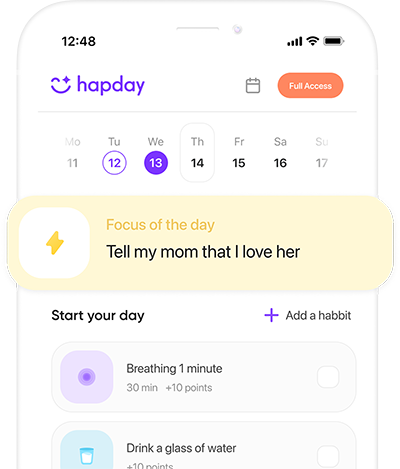
If late-day spirals or weekend wobbles derail you, having structured support between sessions helps. For example, an AI coach like Hapday can provide on-demand check-ins and habit tracking so you catch yourself in the moment, not just at your next appointment. After 2021, on-demand tools moved from novelty to necessity.
Build a Strong Coaching Alliance
A strong relationship with your mental health coach is the engine of change. You’re not there to impress them; you’re there to collaborate. Research on helping relationships consistently shows that feeling understood, setting shared goals, and agreeing on methods predicts better outcomes (APA). In practice, that looks less like pep talks and more like candor about what actually happens at 10 p.m.
How to build that alliance:
- Name your “North Star.” Tell your coach what a better month would look like—sleeping through the night three times a week, a calmer commute, saying no without panic.
- Share your learning style. Do you want frameworks and worksheets? Or stories and body-based practices? Being clear saves months of mismatch.
- Ask for a structure. A light agenda keeps sessions focused: 10 minutes to debrief, 30 minutes to work a skill, 10 minutes to set next steps.
- Offer “process feedback.” Try: “When we move too fast, I shut down,” or “I need help turning insights into two specific actions.”
When Maya, 28, went through her divorce, she met with a mental health coach weekly. Early on, sessions felt meandering; she left with insight but no traction. During week three she said, “I want us to end every session with exactly two actions, and I want you to ask me how they went.” That one request transformed the container. Three months later, her calendar had protected downtime, her sleep stabilized, and she was saying, “I’m not fixed—but I’m proud of how I show up.” In my view, that’s progress with teeth.
Make Sessions Work Harder for You
Most people overestimate what a single hour can do and underestimate what a practiced hour does every week. Treat your sessions like a workout with a warm-up, a focused set, and a cooldown. The goal isn’t to talk about change; it’s to rehearse it.
Why this works:
- Focus narrows overwhelm. When your brain tackles one target at a time, it processes more deeply and encodes skills you can recall later.
- Retrieval practice cements learning. Explaining what worked or didn’t builds metacognition—the ability to notice your own patterns—so you adjust faster.
How to do it:
- Arrive with data, not just vibes. Bring a 1–10 mood rating from the past week, a sleep average, one win, one snag. Your coach doesn’t need perfection; they need patterns.
- Choose one target skill. Maybe it’s “boundary scripts,” “evening wind-down,” or “reframing morning catastrophizing.”
- Rehearse live. Role-play saying, “I can’t take this on until next week,” or practice box breathing together. Doing it once with support boosts the chance you’ll repeat it solo.
“The pillars that most consistently move the mental health needle are sleep, movement, and cognitive coping. We overcomplicate it. Protect bedtime, move your body most days, and practice a brief thought or breathing technique—then repeat for weeks.”
— Dr. Anika Shah, Psychiatrist
Between Sessions: Habits, Tracking, and Friction Fixing
Where coaching quietly changes your life is between appointments. That’s where the new choices live. It’s also where most people decide, midweek, that they’re “off track” when they’re simply in the middle.
Why this works:
- Self-monitoring is a behavior change superpower. Tracking even one behavior increases the odds you’ll repeat it by making progress visible and lapses informational instead of moral.
- Lifestyle inputs shift mood biology. Harvard Health points to strong evidence that regular exercise eases symptoms of depression and anxiety for many people (Harvard Health). The CDC also notes that physical activity reduces anxiety and improves sleep (CDC).
- Sleep is foundational. Most adults need at least 7 hours per night; when you chronically undersleep, mood and attention suffer (CDC).
How to put it into play with your mental health coach:
- Track only what helps action. Pick one or two metrics—sleep window (lights out to wake time) and a daily 0–10 stress check-in.
- Troubleshoot friction, not “willpower.” If your run keeps getting skipped, move it to a different cue (right after coffee) or reduce it (8 minutes). Your coach can help you run experiments instead of shaming yourself.
- Use fast resets. Have two-minute tools you can deploy immediately: 4-7-8 breathing, a 10-sentence brain dump, or a 90-second cold water face splash to activate your dive reflex. NCCIH notes that relaxation techniques and mindfulness can help manage stress and anxiety for many people (NCCIH/NIH).
When late-night rumination hits or a plan falls apart, that’s the exact moment the work matters. Practice pressing the “smallest helpful next step” instead of the perfect plan. If it feels almost too easy, you’re probably on the right track.
Common Roadblocks and How to Pivot with Your Coach
- Perfectionism: You miss one habit and silently declare the week a failure.
What to try with your mental health coach: Elegantly lower the bar. Use “even on my worst day” versions—2 minutes of movement, 3 slow breaths, or sending one boundary text template. Perfection turns fragile; consistency scales. - Emotional avoidance: You keep adding tactics to dodge one tender conversation or grief.
Pivot: Build in micro-exposure. With your coach, script a 90-second check-in to name the feeling, then one 10-minute task that moves the real issue one inch. - Time crunch: You believe you “don’t have time,” then doom-scroll at 11 p.m.
Pivot: Shift from time-based to trigger-based habits. “After I set down my keys, I open my to-do and choose one 10-minute task.” Your mental health coach can help swap fantasies for sturdy routines. - Mismatch with your coach: You feel talked over or under-challenged.
Pivot: Say it. “I need more structure,” or “I want you to challenge my thinking more.” If it still doesn’t fit, it’s okay to choose a new mental health coach. Fit is not a failure; it’s a strategy.
“Clarity beats intensity. We often try to ‘feel motivated’ instead of designing our environment and calendar so the right choice is the easy choice. Your coach is your partner in design.”
— James Porter, PCC-Level Coach
How to Measure Progress With a Mental Health Coach
Progress with a mental health coach isn’t about becoming a different person; it’s about becoming more yourself, more of the time. Measure what matters to your life, not just what looks good. A tidy spreadsheet and a calmer Sunday afternoon are not the same thing.
Build a simple dashboard with your coach:
- Energy: 0–10 each day at noon and 6 p.m.
- Sleep: bed and wake times, number of awakenings
- Movement: minutes of brisk walking or any exercise
- Stress: 0–10 and the situation it happened in
- Coping reps: count how many times you used a breathing or thought reframing skill
- Life proof: one behavior per week that shows you stronger—saying no, sending a portfolio, taking a rest day without guilt
Make it rhythmic. Review every 2–4 weeks. Are sleep windows widening? Are stress spikes shorter? Is your self-talk kinder when you miss a day? Back in 2021, a Harvard-affiliated commentary noted that people tend to underestimate incremental change over a month and overestimate what can shift in a day; your dashboard counters that bias. If a metric breeds shame, drop it.
What to Bring to Your First Three Sessions
Session 1: Why you’re here and what “a better Tuesday” looks like. One or two concerns, plus a list of routines you actually do (coffee, commute, social media). Your mental health coach will map goals onto real cues. The more ordinary, the better.
Session 2: Data and frictions. Share what you tried, what got in the way, and which moments felt different. Ask for a 7-day experiment with a tiny habit and a two-minute reset skill. Expect adjustments; it’s a draft, not a verdict.
Session 3: Boundaries and supports. Identify the one thing you’ll stop doing that costs you peace, and the one support you’ll add (texting a friend after workouts, phone wind-down at 9:45 p.m.). Decide how you’ll check in between sessions if needed. Accountability is a kindness, not a punishment.
Safety, Ethics, and When Coaching Isn’t Enough
A mental health coach is not an emergency resource. If you’re experiencing thoughts of self-harm, severe depression, trauma flashbacks, or substance withdrawal, contact a licensed mental health professional or emergency services immediately. Coaching can be a complement to therapy and medication—never a replacement when clinical care is indicated. The APA’s psychotherapy overview is a good starting point to understand evidenced treatments and how to find a clinician (APA). As one ER psychiatrist told me in 2022, “Right care, right time, saves lives.” It bears repeating.
If you’re working with both a therapist and a mental health coach, consider giving them permission to coordinate on goals. It prevents mixed messages and doubles your support. A short email can spare weeks of confusion.
“Right care, right time, saves lives.”
— ER Psychiatrist
Scripts You Can Borrow With Your Mental Health Coach
- “I want one goal tied to a daily cue and one tied to a weekly cue.”
- “Please reflect back the exact language I use when I’m self-critical.”
- “Let’s role-play the conversation I’m afraid of for five minutes.”
- “If I drift into storytelling, bring me back to, ‘What happens on Tuesday?’”
- “Can we set up a two-week experiment with a success metric that isn’t all-or-nothing?”
How Coaching Interacts With Day-to-Day Health Inputs
You’ll make faster progress with a mental health coach when the basics are in motion:
- Sleep: Aim for a seven-to-nine-hour sleep window and a 30-minute wind-down. CDC guidance emphasizes adults need at least 7 hours; most mental health symptoms worsen with chronic short sleep (CDC).
- Movement: If anxiety spikes, ten minutes of brisk walking can help discharge stress; over time, regular physical activity is linked to better mood and sleep (CDC; Harvard Health).
- Mindfulness or breathing: Even brief daily practice supports attention and emotion regulation (NCCIH/NIH).
None of this has to be perfect. Your coach’s job is to help you right-size the basics so they fit real life. It’s role is to simplify, not to scold.
When Leila, 32, realized her anxiety spiked every afternoon, she and her mental health coach ran a two-week test: a 10-minute walk at 2:30 p.m., a high-protein snack, and a three-breath pause before checking messages. By week two, her 4 p.m. dread score dropped from an 8 to a 5, and she felt steady enough to present at a team meeting. Same job, different nervous system state. For many, that’s the quiet revolution.
The Mindset Shift That Keeps Momentum Going
If you remember one thing, make it this: success with a mental health coach is a practice, not a performance. You’re not auditioning for the role of “wellness person.” You’re experimenting your way into a life that runs more smoothly. Progress often looks like fewer spikes and faster recoveries.
- Expect ambivalence. Wanting change and resisting it are both normal.
- Let data be kind. A missed streak is information, not indictment.
- Ask for more support when you’re wobbling, not after you fall.
“Healing is often boring in the middle. That’s a feature, not a bug. Boring is where you’re rewiring.”
— Dr. Laila Gomez, Clinical Psychologist
If you can tolerate the ordinary, the extraordinary follows—slowly, then all at once??
Closing Summary and CTA
You’re ready to translate care into action: name a better Tuesday, build tiny habits with clear cues, and use your mental health coach as a true collaborator. If you want steady, in-the-moment support while you practice, consider Hapday (hapday.app). It offers 24/7 AI coaching plus mood and habit tracking—handy when you need accountability or a quick reset between sessions with your coach. Bold, consistent steps start now. Rather then perfect, aim for repeatable.
The Bottom Line
Small, specific actions practiced consistently—with a coach who collaborates, challenges, and structures the work—create real momentum. Focus on Tuesday-ready steps, track what matters, and ask for the support you need. Progress is built in ordinary moments.
References
- World Health Organization (WHO) — Depression
- American Psychological Association — Psychotherapy
- Mayo Clinic — Cognitive Behavioral Therapy (CBT)
- Centers for Disease Control and Prevention (CDC) — Physical Activity and Health
- Centers for Disease Control and Prevention (CDC) — How Much Sleep Do I Need?
- National Center for Complementary and Integrative Health (NCCIH/NIH) — Meditation and Mindfulness: What You Need To Know
- Harvard Health Publishing — Exercise is an all-natural treatment to fight depression