

If ADHD is in your relationship, you’ve probably felt the whiplash of good intentions meeting time blindness, distractibility, and emotional intensity. Using the 7 love languages for ADHD offers a shared map for expressing care in ways that actually land. Think of it as translating love into cues that work with an ADHD brain—not against it.
Quick science check: ADHD involves differences in executive functions such as working memory, planning, and inhibition, alongside alterations in dopamine-mediated reward pathways that affect motivation and follow-through (Volkow et al., 2009; Willcutt, 2012). Emotional dysregulation is common—and, when unaddressed, easily fuels conflict cycles if partners miss or misread bids for connection (Shaw et al., 2014; Gottman Institute). Used thoughtfully, the 7 love languages for ADHD encourage cue-rich, time-specific, regulation-friendly connection. My view: the simpler the cue, the more likely it sticks.
Table of Contents
- Why the 7 Love Languages for ADHD Hit Differently
- The 7 Love Languages for ADHD (With Scripts and Systems)
- 1) Words of Affirmation (Cue it and make it concrete)
- 2) Quality Time (Make it time-bound and distraction-proof)
- 3) Acts of Service (Support executive function)
- 4) Physical Touch (Co-regulate the nervous system)
- 5) Gifts (Sensory-smart, meaning-first)
- 6) Routines & Systems (ADHD-specific love language)
- 7) Digital Check-Ins (Modern bids for connection)
- Troubleshooting the 7 Love Languages for ADHD
- A One-Week Starter Plan Using the 7 Love Languages for ADHD
- Key Takeaways
- References
Why the 7 Love Languages for ADHD Hit Differently
- ADHD brains benefit from external structure. Translating affection into visible, time-anchored actions raises the odds of follow-through. “If-then” planning (implementation intentions) remains one of the most reliable tools we have (Gollwitzer, 1999). In practice, it’s the difference between “I’ll try” and “If it’s 8:30 a.m., I text you one appreciation.”
- Predictable, sensory-aware gestures reduce overwhelm, while co-regulation—soothing together—tempers emotional spikes (Shaw et al., 2014). Nervous systems sync; partners settle. In my experience, predictability beats intensity.
- Consistency outperforms grand gestures. The Gottman Institute’s oft-cited 5:1 ratio of positive to negative interactions predicts stability over time. Quiet, repeated investments matter more then one-off surprises.
Note: The original “love languages” framework isn’t a clinical model and shows mixed empirical support (Egbert & Polk, 2006). Still, as a shared vocabulary aligned with what we know about cues, habits, and emotional regulation, it’s practical. Not perfect—useful.
The 7 Love Languages for ADHD (With Scripts and Systems)
Here’s how to bring the 7 love languages for ADHD into daily life—each with cue-based habits and science-informed tweaks.
1) Words of Affirmation (Cue it and make it concrete)
- What works: Short, specific, scheduled praise (“I loved how you texted me before your meeting—felt so cared for”). Micro-affirmations help maintain that 5:1 ratio without fanfare.
- System: Phone reminder at 8:30 a.m.: “Send 1 appreciative text.”
- Script: “Hearing ‘I appreciate you for X’ keeps me regulated and focused.”
- A note of opinion: precise beats poetic when attention is stretched.
2) Quality Time (Make it time-bound and distraction-proof)
- What works: “Ten-minute, headphones-off check-in after dinner.” Time-boxing reduces anticipatory anxiety and increases presence.
- System: Shared calendar event + visible phone basket on the table.
- Script: “Let’s do 10 minutes fully present—timer on so my brain can relax.”
- My take: brief and protected outperforms long and porous.
3) Acts of Service (Support executive function)
- What works: Body doubling (doing parallel tasks together) and “starter help” on hard tasks—ADHD brains often need momentum to get moving.
- System: Sunday 20-minute reset: one clears counters, one starts laundry.
- Script: “If you start the first step, my brain can finish it.”
- Opinionated but honest: momentum is medicine here.
4) Physical Touch (Co-regulate the nervous system)
- What works: Predictable touch routines—20-second hugs can boost oxytocin and ease stress; slow breathing together supports regulation.
- System: “Three-breath hug” before tough conversations.
- Script: “Can we do our 20-second hug? It helps me settle.”
- I’ve seen routine touch calm storms faster then words alone.
5) Gifts (Sensory-smart, meaning-first)
- What works: Small, sensory-friendly items (weighted lap pad, soft socks, fidget ring) that meet real needs—and don’t create clutter.
- System: Shared “Love List” in notes with sizes, snack favorites, and sensory preferences.
- Script: “Tiny, useful surprises help me feel seen, not cluttered.”
- My bias: function over flash.
6) Routines & Systems (ADHD-specific love language)
- What works: Shared rituals (Friday plan-jam, morning checklists, visual timers). Externalizing memory is an act of care, not control.
- System: Magnetic weekly board with “meals, chores, 2 connection blocks.”
- Script: “When we use the board, I feel safe and show up better.”
- Editorial note: systems are intimacy infrastructure.
7) Digital Check-Ins (Modern bids for connection)
- What works: Emoji pings, brief voice notes, a photo from your day. Short, frequent “thinking of you” nudges hit reward circuits reliably.
- System: Two scheduled touchpoints (9 a.m. and 3 p.m.) with a cue (coffee = send pic).
- Script: “Your quick ‘thinking of you’ note keeps me connected all day.”
- I’d argue a 12-second voice memo can do what a long text can’t.
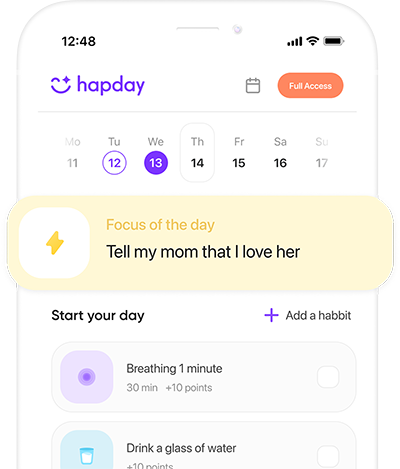
For building these into real habits, platforms like Hapday offer round-the-clock coaching and breathing exercises you can use right before a hard conversation—handy when ADHD emotions surge at inconvenient times. No app fixes a relationship, but the right tool lowers friction.
Troubleshooting the 7 Love Languages for ADHD
- Make it measurable. “Be more affectionate” becomes “three-breath hug after work.” Implementation intentions (“If X, then Y”) consistently improve follow-through (Gollwitzer, 1999).
- Shrink the win. Lally et al. (2010) found habit formation takes weeks to months; starting tiny preserves consistency and dignity.
- Use visual proof. A fridge tracker for “connection reps” keeps momentum visible to a brain that forgets past wins quickly.
- Repair fast. If a bid gets missed, try: “I got distracted and I’m sorry. Can I redo that now?” Turning toward bids is what counts most (Gottman Institute).
- Calibrate sensory needs. Touch, sound, and clutter tolerance vary; treat preferences as data, not verdicts. In my book, curiosity beats conviction.
A One-Week Starter Plan Using the 7 Love Languages for ADHD
- Mon: Words—send one specific appreciation at 8:30 a.m.
- Tue: Acts—start their stuck task for five minutes.
- Wed: Quality time—10-minute device-free chat after dinner.
- Thu: Touch—20-second hug + slow exhale together.
- Fri: Systems—15-minute plan-jam with the wall calendar.
- Sat: Gifts—one tiny, sensory-smart item from the Love List.
- Sun: Digital—voice note with a “peak/valley” of your week.
Image alt: 7 love languages for ADHD partners creating a weekly connection plan
Key Takeaways
The 7 love languages for ADHD work best when translated into tiny, cued, sensory-aware actions you can repeat. If you want structured support to make these stick, consider Hapday. It’s an AI life coach used by millions, with 24/7 coaching and habit tracking to help turn connection into a steady practice.
References
- Volkow, N. D., et al. (2009). Evaluating dopamine reward pathway in ADHD. JAMA. https://jamanetwork.com/journals/jama/fullarticle/185157
- Willcutt, E. G. (2012). The prevalence of ADHD: A meta-analytic review. Neurotherapeutics. https://link.springer.com/article/10.1007/s13311-012-0135-8
- Shaw, P., Stringaris, A., Nigg, J., & Leibenluft, E. (2014). Emotion dysregulation in ADHD. American Journal of Psychiatry. https://ajp.psychiatryonline.org/doi/full/10.1176/appi.ajp.2013.13070966
- Gottman Institute. The Magic Relationship Ratio. https://www.gottman.com/blog/the-magic-relationship-ratio-according-science/
- Egbert, N., & Polk, D. (2006). Speaking the language of love. Communication Quarterly. https://www.tandfonline.com/doi/abs/10.1080/01463370601036568
- Gollwitzer, P. M. (1999). Implementation intentions. American Psychologist. https://psycnet.apa.org/record/1999-10171-006
- Lally, P., et al. (2010). How are habits formed in the real world? European Journal of Social Psychology. https://onlinelibrary.wiley.com/doi/10.1002/ejsp.674