

When you grow up around chaos, criticism, or manipulation, the pressure to “just move on” can feel like a betrayal of your own nervous system. Forgiveness, pursued carefully, is not about excusing harm; it is about reclaiming energy and protecting long‑term health while honoring what you lived through. Hard truth: you can care about repair and still prioritize distance — both can be true.
Table of Contents
- What forgiveness is (and isn’t) when family is toxic
- A safety-first plan to forgive toxic family members
- How to forgive toxic family members step by step
- Contact choices that protect your nervous system
- Evidence-backed tools that help forgiveness stick
- When not to forgive right now
- Conversation templates to try
- Maintenance: keep what you gained
- Closing summary and CTA
- References
What forgiveness is (and isn’t) when family is toxic
- Forgiveness is a personal health choice, not a reunion plan. Scholars distinguish decisional forgiveness (choosing to replace revenge/avoidance with value‑driven behavior) from emotional forgiveness (the gradual thawing of resentment) (Worthington, 2006). You can forgive while keeping distance — or while keeping no contact at all. In my view, that’s a saner definition than the usual “hug it out” script.
- Why consider it? Chronic family conflict wears down the body. Laboratory work has shown that hostile exchanges boost inflammatory markers and even slow wound healing (Kiecolt‑Glaser et al., 2005). Meta‑analyses suggest forgiveness programs offer small‑to‑moderate gains in depression, anxiety, and hope (Wade et al., 2014). Back in 2021, a Harvard‑affiliated review echoed the same pattern: tiny steps, real effects over time.
- Context matters. Many adults carry adverse childhood experiences. U.S. estimates suggest 61% have at least one ACE and 1 in 6 have four or more, elevating lifetime mental and physical risks (CDC, 2019). Any forgiveness effort should be trauma‑aware and paced for safety — rushing helps no one.
A safety-first plan to forgive toxic family members
- 1) Screen for risk. If there is any chance of violence, stalking, or financial control, do not confront alone. Use a safety plan, document patterns, and lean on local resources or a licensed professional. This is not overcautious; it is adult.
- 2) Define your outcome. You can forgive without contact. Decide whether your goal is:
- Peaceful neutrality (lowering the emotional charge)
- Civil but boundaried contact
- Structured low/no contact
- 3) Boundaries before bridges. Boundaries protect the present; forgiveness processes the past. Write three non‑negotiables (e.g., “No yelling,” “No surprise visits,” “Money stays separate”) and one or two consequences you will enforce. Without consequences, boundaries are wishes.
- 4) Grieve what won’t change. Many people find that forgiving also means mourning the parent or sibling they wished they had. Naming the loss reduces rumination and makes forgiveness more realistic. It is the quiet grief few families acknowledge.
How to forgive toxic family members step by step
- Step 1: Decisional forgiveness. Draft a brief commitment: “I choose to stop re‑litigating the past daily and to act from my values: calm, dignity, and safety.” Decisional forgiveness can reduce revenge and avoidance even while anger remains (Worthington, 2006). It’s less a moral verdict then a health strategy.
- Step 2: Emotional processing. Use guided writing: 15–20 minutes, 3–4 days, about what happened, how it changed you, and what you carry forward. A meta‑analysis of expressive writing found consistent mental and physical benefits (Frattaroli, 2006). On the page, clarity often arrives after the third session… not the first.
- Step 3: Reframe without minimizing. Try: “They were limited and harmful; both can be true. I am not obligated to carry their unhealed pain.” A sober reframe beats a rosy rewrite.
- Step 4: Script and practice. If you maintain contact, prepare one‑liners:
- “I’m not discussing politics at family dinners. If it continues, I’ll leave.”
- “I won’t be insulted. I’m ending this call now.”
- “We can meet for one hour at the café on Saturday.”
Rehearsal is not theatrical; it’s protective.
- Step 5: Pace and measure. Expect waves. Track sleep, stress, and triggers for 4–6 weeks. Forgiveness typically grows with repeated practice and support (Wade et al., 2014). Your nervous system does it’s math slowly.
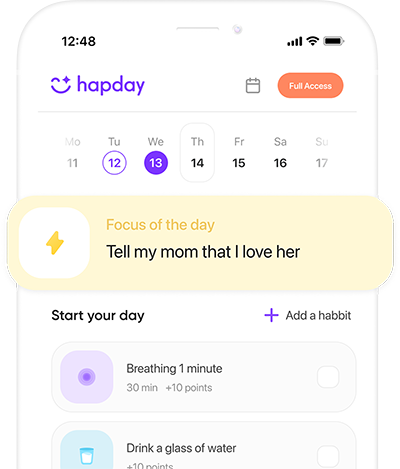
If late‑night rumination is the sticking point, consider a coach‑on‑call approach: platforms like Hapday offer 24/7 AI coaching sessions and evidence‑based prompts so you can reality‑check a boundary script or de‑escalate stress in the moment it spikes. The Guardian reported in 2020 that estrangements rose during the pandemic; having structured support during off‑hours isn’t indulgent — it’s pragmatic.
Contact choices that protect your nervous system
- Low contact: Scheduled, time‑limited interactions with clear topics. Use text or email for logistics; avoid reactive phone calls. Predictability is an ally here.
- Medium contact with filters: Meet in public spaces; bring an ally; leave if boundaries are crossed. This is etiquette with teeth.
- No contact: Sometimes the only safe route. You can still forgive privately to free yourself from ongoing resentment while remaining unreachable. No one else gets a vote on this.
Evidence-backed tools that help forgiveness stick
- Self‑compassion: Studies link self‑compassion with higher well‑being and resilience, supporting forgiveness work without self‑blame (Zessin et al., 2015). Try: “What would I tell a friend who lived through this?” In my experience, this single prompt changes tone more than any mantra.
- Physiological downshifts: Box breathing (4‑4‑4‑4), a brief walk, or cold‑water face splashes lower arousal so you can enforce boundaries without exploding. Body first, conversation second.
- Micro‑repairs with yourself: After difficult contact, do a 10‑minute decompression ritual — journal, shower, stretch, message a trusted friend. Consistency wires safety. Small rituals beat grand plans.
When not to forgive right now
- If you are still securing legal, financial, or housing safety.
- If contact reliably worsens symptoms (panic, self‑harm urges, relapse).
- If forgiveness pressure is coming from outsiders who won’t protect you.
Waiting is not failure; it is wise stewardship of a taxed nervous system. You can revisit forgiveness when your baseline steadies. Sometimes postponement is the bravest call.
Conversation templates to try
- “I’m willing to see you for coffee for 45 minutes; no drinking and no comments about my body. If that happens, I’ll leave and reschedule in a month.”
- “I’m focusing on healing. I’m not ready to talk about the past, and I won’t be answering texts after 8 p.m.”
- “I’m choosing forgiveness for my peace, but I’m also choosing distance. Please respect no contact.”
These are firm, not cruel — clarity is a form of care.
Maintenance: keep what you gained
- Review boundaries quarterly; keep what works, revise what does not.
- Mark small wins: fewer arguments, better sleep, more neutral responses. Progress, not perfection, is the goal.
A simple calendar reminder every three months beats heroic willpower.
Closing summary and CTA
Forgiveness is a health practice, not a reunion policy. Define safety, set enforceable boundaries, grieve the losses, and use structured tools to forgive toxic family members on your terms. If you want help translating this into daily behavior, consider Hapday (hapday.app) for around‑the‑clock coaching and habit tracking that support boundaries while you heal. Steady is faster than fast.
References
- Wade, N. G., et al. (2014). Efficacy of psychotherapeutic interventions to promote forgiveness: A meta-analysis. Journal of Consulting and Clinical Psychology. https://psycnet.apa.org/record/2014-03173-001
- Kiecolt-Glaser, J. K., et al. (2005). Hostile marital interactions, proinflammatory cytokine production, and wound healing. Archives of General Psychiatry. https://jamanetwork.com/journals/jamapsychiatry/fullarticle/208609
- Centers for Disease Control and Prevention (2019). Preventing Adverse Childhood Experiences (ACEs). https://www.cdc.gov/violenceprevention/aces/fastfact.html
- Frattaroli, J. (2006). Experimental disclosure and its moderators: A meta-analysis. Psychological Bulletin. https://pubmed.ncbi.nlm.nih.gov/17073523/
- Worthington, E. L. (2006). Forgiveness and reconciliation: Theory and application. Routledge. https://doi.org/10.4324/9780203942048
- Zessin, U., Dickhäuser, O., & Garbade, S. (2015). The relationship between self-compassion and well-being: A meta-analysis. Applied Psychology: Health and Well-Being. https://onlinelibrary.wiley.com/doi/10.1111/aphw.12051
- Toussaint, L., Owen, A. D., & Cheadle, A. (2012). Forgiveness and health: A review and theoretical exploration. Journal of Behavioral Medicine. https://link.springer.com/article/10.1007/s10865-012-9448-5