

Table of Contents
- Grasping Self-Love: Beyond a Catchphrase
- The Psychology of Self-Love: Why It All Counts
- Tackling Obstacles to Self-Love
- Strategic Steps to Nurture Self-Love
- Technology’s Role in Self-Love
- Scientific Support for Self-Love
- Building a Long-lasting Self-Love Practice
- The Path Forward with Poise
Key Takeaways
- Self-love is essential for mental well-being and resilience.
- Set boundaries and practice self-compassion for better self-esteem.
- Engage in activities that bring joy and embrace imperfections.
- Utilize technology and support networks to aid in self-love practices.
- Commit to a long-term self-love journey, treating setbacks with kindness.
Picture this: it’s evening, the kind where the sky is a patchwork of oranges and pinks. Mia, 26, a graphic designer by trade, leans back on her couch flipping through Instagram. The feed overflows with seamless images—folks living ultra-polished lives. Each snapshot, a silent critic, has her questioning, “Why not me?” The frustration—it’s palpable.
Sound familiar? If you’re nodding, take a breath. You’re in good company. The trek towards loving oneself—it’s no straight line. Society pulls us in all directions, throwing comparisons in our way while our toughest critic stares us down in the mirror.
Grasping Self-Love: Beyond a Catchphrase
Self-love. It’s tossed around a lot these days, isn’t it? Beneath the buzz, it’s about valuing yourself. Seeing your strengths, knowing your worth. According to
“cultivating self-love is treating ourselves with that same kindness we reserve for pals, especially in tough times.”
— Dr. Kristin Neff, Self-Compassion Researcher
This life’s work? Essential for mental well-being. It smooths the road to resilience, cuts through anxiety, and bolsters our emotional health.
And backed by numbers too. The American Psychological Association tells us, folks who practice this self-compassion game report less anxiety, less gloom. Self-love isn’t just a nice-to-have; it’s crucial for our minds.
The Psychology of Self-Love: Why It All Counts
Loving yourself? It’s laying that solid mental groundwork for boundaries and healthy bonds. In positive psychology, self-love acts like a shield against stress. Think of Maya, 28, reeling from a divorce. Her road to recovery started by nurturing self-love.
“Meeting myself anew.”
— Maya, Self-Love Advocate
Those self-reflective days helped her heal, a testament to the strength found by looking inward.
Dr. Rachel Geller, a therapist and author, points out that self-love goes beyond feeling nice. It’s about embracing both our strengths and weaknesses. Your worth? It’s not tied to life’s scoreboard or others’ approval.
Tackling Obstacles to Self-Love
But let’s get real. The path isn’t easy, especially for the millennial and Gen Z women among us, who are under a magnifying glass of societal pressures. According to the National Institute of Mental Health, anxiety disorders have climbed sharply in young women, thanks largely to the social media vortex and career race.
To grow self-love, recognizing these barriers is paramount. Negative self-talk? Perfectionism? People-pleasing? All hurdles. Rather than deny or hide from them, it’s about seeing them as stepping stones on the path forward.
Strategic Steps to Nurture Self-Love
- Practice Self-Compassion: Imagine treating yourself with the kindness you extend to your closest friend. Self-compassion fosters gentler self-talk, slicing away shame and inadequacy. Dr. Neff says to begin with mindfulness—staying present without that nagging judgment. Why? Neuroscience lays it out: mindfulness nudges the prefrontal cortex—key to regulating emotions—helping minimize those intrusive, negative thoughts.
- Set Boundaries: Setting boundaries is vital for nurturing healthy relationships and ensuring your priorities get the respect they deserve. Sophie, a 30-year-old software engineer, found freedom when she learned to say no, escaping the burden of people-pleasing. Studies from the Journal of Happiness Studies back this up; women with firm boundaries benefit from a higher self-esteem, protecting their personal energy.
- Do Activities That Feed Your Soul: Unearth activities that bring you joy and fulfillment. Be it creative projects, volunteering, or basking in nature. The science is on your side: hobbies spark dopamine—the happy hormone—lifting your spirits and well-being. Start by marking some time for what you love. Maybe it’s painting, hiking, or even gardening. These nourish your creative self and enhance your mood.
- Embrace Imperfections: Lovin’ your flaws is a self-love staple. Perfect’s a myth, especially online. Embracing your quirks, your flaws? It’s about appreciating what makes you, well, you. A study from the Personality and Social Psychology Bulletin links self-acceptance to better psychological well-being and satisfaction. To begin, jot down those quirks and see how they add to your uniqueness. Shift perceived weaknesses into strengths by finding the beauty in them.
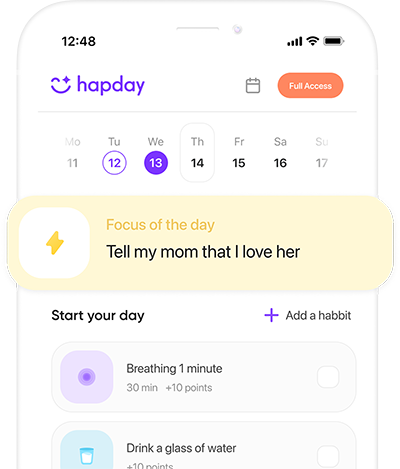
- Seek Support: There will be times when self-love feels like a Herculean task. In those instances, external support changes the game. Platforms like Hapday, used by 3 million people for everyday mental health coaching, can guide your journey by offering mood tracking and personalized help. They say support networks—real or virtual—combat isolation and build community bonds.
- Cultivate Gratitude: Gratitude flips the script from lack to abundance. When you savor life’s little blessings, self-love emerges naturally. And this isn’t just fluff. Research by Dr. Robert Emmons, gratitude guru, confirms its potency—continual gratitude practice enhances happiness. Start a gratitude journal. Daily jot down three things you’re thankful for. Cherish those moments, people, and experiences that light up your life.
Technology’s Role in Self-Love
Tech—our modern conundrum. Social media can tempt comparisons, yet apps like Hapday can build healthy self-care routines. Picture it’s 2 AM, and your mind’s racing—Hapday’s AI coach lets you talk it out, no waiting. Um, apps with breathwork, habit tracking, or sleep aid programs? They’re pretty handy, nudging us to care for ourselves amidst chaos.
Scientific Support for Self-Love
Self-love isn’t just frou-frou; it has roots in psychology and neuroscience. Embrace oneself, and the body’s like, “I got you.” Oxytocin, the soothing ‘love hormone,’ elevates, calming us. Cortisol, the stress-inducer, drops, boosting resilience.
Building a Long-lasting Self-Love Practice
Long-term self-love isn’t a checkbox, it’s a commitment. It takes patience, more journey than destination. When setbacks strike, treat yourself gently. It’s normal to waver.
The Bottom Line
Self-love. It’s akin to planting seeds of resilience that bloom into a healthy mind. By nurturing compassion, setting boundaries, and accepting your beautiful quirks, you lay a base for wellness. Choosing yourself is an act of love—not just for you, but for those around you.
Need help battling late-night anxiety? Real-time support helps. Hapday has 24/7 AI coaching for those times. Self-love’s journey benefits your mental health and life.
Sources:
- American Psychological Association – https://www.apa.org
- National Institute of Mental Health – https://www.nimh.nih.gov
- The Journal of Happiness Studies – https://link.springer.com/journal/10902
- Personality and Social Psychology Bulletin – https://journals.sagepub.com/home/psp
- Dr. Robert Emmons’ Gratitude Research – https://emmons.faculty.ucdavis.edu