



Picture yourself standing amid the familiar comforts of your living room, Saturday morning serenity paused, partly disrupted by unsettled thoughts. The soft tick of the clock reminds you of moments slipped by—little stitches in a quilt of regret. Guilt, that old companion, has draped itself over your heart again. It could be the pang of not keeping in touch with family, shelving a passion project, or residue from a soured relationship. This burdensome shadow can feel immobilizing if left unchecked. But here’s the silver lining—through intention and action, you can unravel its grasp and seize control of your life, starting right now.
Ah, guilt… It wears the mask of a destructor, yet its pervasive nature hints at an intention of purpose—or so it begins.
“Guilt is that social guardian nudging us to abide by communal norms from a tender age.”
— Dr. Sarah Chen, Clinical Psychologist
It acts as a moral compass, a call to rectify missteps and maintain our ethical balance. But when guilt overstays its welcome, morphing into an omnipresent specter, it saps joy and stalls growth.
Table of Contents
- Understanding Guilt: Friend or Foe?
- The Psychological Cost of Guilt
- Why Rethinking Your Narrative Works
- Tips for Breaking Free: Steps Toward Healing
- Real-World Solutions—Incorporating Healthy Habits
- The Role of Gratitude in Transforming Guilt
- Empowered Futures: From Guilt to Growth
- References
Key Takeaways
- Guilt can be adaptive or maladaptive; understanding this difference is crucial for emotional health.
- Self-compassion and mindfulness are key tools for managing feelings of guilt.
- Making amends and setting realistic narratives can help alleviate guilt.
- Gratitude helps shift focus from guilt to appreciation.
- Professional therapy can provide valuable strategies for handling guilt.
Understanding Guilt: Friend or Foe?
Tackling guilt’s grip starts with knowing what makes it tick. Broadly, there are two shades of guilt: adaptive and maladaptive. Adaptive guilt is like a guide, nudging us to amend our ways or behaviors. Maladaptive guilt, however, gets you trapped in an endless loop of regret over past mistakes or undue responsibility for issues far beyond your realm of control—a mirage rather than reality.
Take Maya, for instance. At 28, she waded through the turbulent waters of divorce, awash with the guilt of not foreseeing the end or being the partner she thought she should be. Her breakthrough? Realizing the thin line between responsibility and unfounded guilt.
“Guilt becomes maladaptive when it’s so woven into our psyche that it distorts our self-worth.”
— Dr. Sarah Chen, Clinical Psychologist
Understanding it’s not just the action but our response that holds the key to breaking free. Intriguing, isn’t it?
The Psychological Cost of Guilt
Guilt, when left unchecked, leeches into our mental well-being. It’s been inseparably linked to anxiety and depression, and can even manifest physically as insomnia or a compromised immune system—so says the American Psychological Association. The danger lies in guilt’s power to stifle our choices, leaving us helplessly spinning the wheels of reflection without a road to solution.
Behavioral theories from cognitive psychology suggest that guilt can carve itself into a habit, reinforced by a vortex of negativity. Learning to recognize these cycles and pivot—moving from introspection to forgiveness—demands both awareness and determination. It’s like redirecting a river’s course—challenging but achievable.
Why Rethinking Your Narrative Works
Should guilt script your life? Rewrite that tired script! Often, we magnify our missteps and bypass the path of redemption. Reframing helps us reinterpret our actions, recognizing mistakes not as failures but learning curves.
Try cognitive restructuring, a nifty tool to challenge warped thinking. Caught in “I can never set this right” thinking loops? Swap out for a more balanced, “I can learn and strive to do better.”
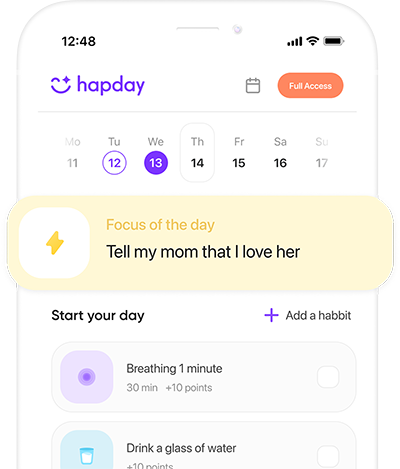
Visualize this: late at night, when life’s movie replays itself in your mind on loop. Apps like Hapday, with millions already invested in its AI life guidance, await to string together your fragmented thoughts with 24/7 support and science-backed techniques.
Tips for Breaking Free: Steps Toward Healing
Once you seize a clearer understanding of guilt, it’s time to lay down the tracks for progress. Here are real steps for easing guilt’s grip:
- Practice Self-Compassion: Extend kindness to yourself. Self-compassion’s about treating yourself like a dear friend.
“In cultivating self-compassion, judgment gives way to gentle understanding.”
— Dr. Kristin Neff
- Focus on the Present: Mindfulness can anchor you in the now. Meditation and deep breathing can break free of guilt loops by grounding you—right here, right now.
- Use Forgiveness as a Tool: Forgiving oneself, while a trek, unlocks immense emotional release. Use affirmations to ease into acceptance and set the stage for a guilt-free emotional landscape.
- Get Professional Help: The heft of guilt can be too much on one set of shoulders. Therapy offers clarity and equips you with strategies to manage guilt. It’s about tracing the roots and crafting lasting change.
- Make Amends if Possible: If your guilt stems from correctable actions, reach out and mend fences. Sincere apologies or proactive measures close an emotional chapter, offering liberation to you and others affected.
Real-World Solutions—Incorporating Healthy Habits
Healthy habits tip the emotional scales in your favor, quelling guilt’s persistent murmur. Regular exercise, creative pursuits, or lending a hand to your community are effective boosters for mental well-being.
In a time when mental health tools are at our fingertips, apps like Hapday shine, delivering custom journeys in habit-building and stress management. Imagine tracking your progress, incrementally easing guilt, and spreading positive actions step by step.
The Role of Gratitude in Transforming Guilt
Gratitude, from a psychological angle, tempers guilt. It pivots focus to cherished memories and accomplishments rather than what’s amiss. Harvard research found gratitude fluffing up happiness, spotlighting the silver lining amid the storm.
Consider a gratitude journal. Each day, pen down bits of gratitude, rewiring your brain to seek out positives. This tiny act alters your outlook, melting guilt away and paving paths for acceptance.
Empowered Futures: From Guilt to Growth
You’re not journeying alone. Millions, every day, struggle with guilt’s leaden cloak. An inner battle transforms to outward growth, and by untangling guilt’s grip, you encourage personal wellness and resilience. Your story becomes a beacon of transformation for others.
With strategies and solutions from this article in your toolkit, contemplate adding Hapday’s touch to your journey. This AI coach, available anytime, guides you to growth and healing—offering peace of mind you didn’t know you craved.
Freeing yourself from guilt today plants the seeds of transformation. If you’re all set to live beyond past shadows, give Hapday a whirl at hapday.app. Its round-the-clock AI coaching molds avenues for moving beyond guilt, harnessing them into opportunities for self-growth.
The Bottom Line
Breaking free from guilt is not an unwinnable battle—it’s your path to reclaiming power. Start this journey, bolstered by compassion, fresh perspectives, and wise tools. Freedom’s possible—one step at a time.
References
- American Psychological Association – https://www.apa.org
- Harvard Health Publishing – https://www.health.harvard.edu
- Mayo Clinic – https://www.mayoclinic.org