



Table of Contents
- Understanding the Roots of Guilt
- The Science Behind Lingering Guilt
- Unleashing the Power of Self-Compassion
- Practical Techniques to Let Go
- Repair and Reconnect: The Role of Amends
- Why Forgiving Yourself is Critical
- Leveraging Support Systems
- The Reinforcement of New Habits
- Why Guilt Can Transform Into Growth
- Empowering Your Journey Forward
Key Takeaways
- Guilt can hinder mental health but understanding its roots is crucial for liberation.
- Practice self-compassion to mitigate the effects of guilt on your well-being.
- Reframing thoughts and mindfulness techniques can help you let go of guilt.
- Making amends and self-forgiveness are essential in healing from guilt.
- Community support and new habits can reinforce your journey away from guilt.
Understanding the Roots of Guilt
Guilt isn’t just a momentary pang—it’s a stubborn weight that can smother your mental health.
“Guilt is an intricate emotion that often arises when our actions—or what we perceive as lack thereof—clash against our personal values or societal norms.”
— Dr. Sarah Chen, NYU
Our social nature doesn’t help; we’re hardwired to uphold certain standards, and falling short sparks guilt.
The American Psychological Association has linked this emotion to an evolutionary tool—our ancestors needed it to stay harmonious in groups. Yet, in today’s world, guilt sometimes morphs into something maladaptive, spiraling into anxiety and depression.
The Science Behind Lingering Guilt
Before we break free, let’s figure out why guilt lingers. Neuroimaging shows that guilt stirs up the same brain parts involved in self-reflection—like the medial prefrontal cortex. Researchers at the University of Cambridge found this neural network often fixates on past mistakes, anchoring us in cycles of self-chastisement.
Interestingly,
“Our brains are wired with a bias towards negativity. We recollect negative experiences more vividly than positive ones.”
— Dr. Michael Ferguson, Harvard
This built-in tendency can amplify our guilt, blurring our ability to assess situations rationally.
Unleashing the Power of Self-Compassion
Liberating oneself from guilt starts with a shift—a pivot towards self-compassion. Imagine if Maya, instead of harshly judging herself, showed the kindness she’d give a friend.
“Embracing our shared humanity and treating ourselves gently can drastically reduce feelings of guilt.”
— Kristin Neff, Self-Compassion Expert
Practicing self-compassion isn’t just emotional indulgence. Picture writing a dialogue with yourself, as though you’re chatting with your best mate. Acknowledge, validate, and remember: everyone errs. Studies suggest this can actually diminish anxiety and depression symptoms (Neff, 2011).
Practical Techniques to Let Go
To shed guilt, try cognitive reframing—a method for challenging and shifting harmful thought patterns. Pinpoint the story you’ve spun around your guilt. If “I failed my marriage” is your mantra, flip it to “I did my best under tough circumstances.”
“Our thoughts sculpt reality. By reframing, we’re not ignoring events; we’re reshaping our understanding for balance.”
— Dr. Carol Kershaw, Author
Couple this with mindfulness—like breathing exercises that ground you in the present—and you’ve got potent tools for easing guilt.
Repair and Reconnect: The Role of Amends
Sometimes, guilt signals the need for mending fences. If it’s about harm done to others, making amends can deeply heal. Offer that sincere apology—research confirms it fosters forgiveness and eases negative emotions on both sides.
A heartfelt letter, a direct conversation, or even small, kind gestures that signal a commitment to improve can do wonders. It’s about creating avenues for healing for those involved—including yourself.
Why Forgiving Yourself is Critical
Self-forgiveness is perhaps the hardest part of moving past guilt, yet essential. Holding onto self-directed anger breeds stress, a route to health issues, warns the CDC. Self-forgiveness isn’t justifying poor actions; it’s about granting yourself the freedom to build healthier patterns.
“Forgiving oneself allows for release from punitive self-judgment, setting the stage for constructive change.”
— Dr. Sarah Chen, NYU
Leveraging Support Systems
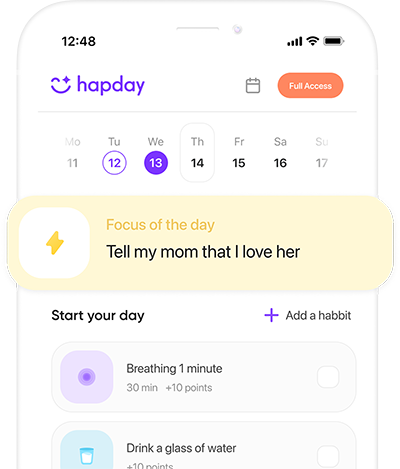
Guilt can sometimes demand an outside perspective for better navigation. Therapy offers a safe space to delve into these issues. But if therapy feels out of reach, platforms like Hapday might be the key. Used by millions, it offers an affordable blend of evidence-based coaching available round the clock.
Engaging in community or support groups where similar experiences are shared can lighten the load of guilt. You’ll be reminded of your innate worth, notwithstanding past errors.
The Reinforcement of New Habits
Carving new habits is key to breaking free from guilt’s grip. The habits we foster can reshape how we see ourselves. Routines that align with personal values can bolster self-esteem and shift our narrative.
Using digital platforms for habit tracking helps keep you grounded in new, positive behaviors. Setting realistic goals and noting progress not only builds a positive self-image but also dismantles cycles of guilt.
Why Guilt Can Transform Into Growth
While guilt may seem limiting, it can also be a catalyst for growth. It nudges introspection and, if managed well, spurs meaningful change. Ask yourself: what’s my guilt illuminating about my true priorities? Transform it from a tormentor into a teacher, redirecting focus from blame to growth.
“Constructive use of guilt turns it into a launchpad for personal growth, aligning behaviors more closely with core values over time.”
— Dr. Michael Ferguson, Harvard
Empowering Your Journey Forward
Breaking the chains of guilt is a journey, requiring patience. With self-compassion, reframing, mindfulness, and support, you reclaim your story. Remember Maya? By choosing a similar path, she reframed her divorce as a step towards authenticity, not failure.
Want genuine support in this? Hapday (hapday.app) offers evidence-based coaching round the clock, used by over 3 million people aiming for emotional liberation.
The Bottom Line
Freeing yourself from guilt is not just possible; it’s a necessary journey towards emotional well-being. By embracing self-compassion, reframing your thoughts, and utilizing support systems, you can transform guilt into growth and reclaim your narrative.
References
- American Psychological Association – https://www.apa.org
- Centers for Disease Control and Prevention – https://www.cdc.gov
- Neff, K. D. (2011). Self-compassion, self-esteem, and well-being. Social and Personality Psychology Compass. Reference is broader; refer to Neff at http://self-compassion.org
- University of Cambridge – https://www.cam.ac.uk