



Table of Contents
- Understanding Stress and Its Impact
- Mindfulness as a Remedy
- Applying Mindfulness Techniques
- The Science Behind Mindfulness
- Integrating Mindfulness in Daily Life
- Real-life Success Stories
- Overcoming Challenges in Mindfulness Practice
- Empower Yourself with Mindfulness
- References
Understanding Stress and Its Impact
Stress. It’s a word thrown around so casually nowadays, isn’t it? But let’s pause a moment. Beyond the workplace banter and midnight complaints, it’s a beast with real teeth. You’ve probably heard it affects your body in sneaky ways—literally from head to toe. The American Psychological Association has delved deep into this, showing that stress can unsettle not just your mind, but your heart, your immune system, even the very rhythm of your digestion.
The biological backdrop here is a tale as old as time. Imagine your body as a battleground where hormones like cortisol and adrenaline surge in, arming you for action. But if left unchecked, this constant battleground can become a war of attrition on your health. As the towering deadlines of Maya’s workplace continued to bear down, she realized chronic stress was turning her world into one of permanent tension.
“Your body’s on high alert, all the time, no reset… it’s unsustainable.”
— Dr. Sarah Chen, NYU
Mindfulness as a Remedy
Enter mindfulness — an ancient practice reaching from the past to offer solace in our modern, digital cacophony. Let’s not sugarcoat it: mindfulness isn’t a magic wand. But it is a proven method to tackle stress. As Jon Kabat-Zinn, the mind behind Mindfulness-Based Stress Reduction (MBSR), describes it quite poignantly: it’s paying razor-sharp attention to the present, living each moment like it’s your only one.
Harvard University’s studies echo this sentiment, revealing how mindfulness doesn’t just soothe stress but ramps up your mental agility and emotional toughness. Isn’t that something we all could use a bit more of? With mindfulness, your brain rewires itself — not overnight, but measurably over time.
“It’s about crafting a buffer zone for the soul, a space where reactions become choices.”
— Dr. Ellen Langer, Harvard
Applying Mindfulness Techniques
Now, how do we apply these age-old techniques to our crazy lives?
Mindful Breathing
Ah, breathing—it’s something we all do but seldom really pay attention to. Mindful breathing is grounding, focusing on the rhythmic ebb and flow of your breath. And why not? A breather here and there has been shown in NIH research to dial back cortisol, slaying the stress monster, one breath at a time.
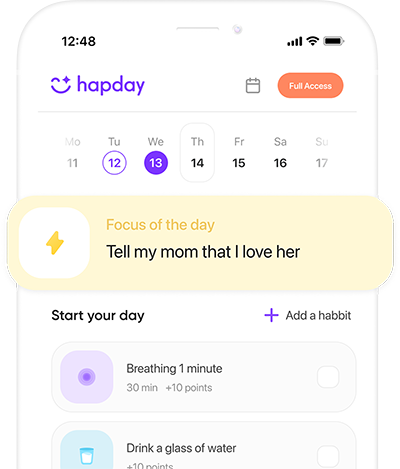
Picture this: It’s 2 a.m., and your mind resembles a hamster wheel stuck on overdrive. Happily, the world now offers AI coaches like Hapday for a digital hand-hold through those moments.
Body Scan Meditation
Another technique—body scan meditation. Picture your mind gently traversing your body, acknowledging tensions as they arise, and gradually releasing them. It’s therapeutic, like peeling off layers of stress you didn’t even realize were there. A Mayo Clinic study showed that those engaged in body scanning felt a decrease in stress and a boost in well-being. Who could say no to that?
Mindful Walking
For those who can’t spare a moment, mindful walking slips seamlessly into your routine. Walk the way a cat prowls: attentive, deliberate.
“This practice, amid life’s incessant rush, gifts you moments of solace.”
— Dr. Andrew Weil
The Science Behind Mindfulness
Let’s dive a bit deeper into the science-y side: Mindfulness training tweaks your brain’s physical structure — no small feat. The University of Massachusetts Medical School found rapid mental health improvements after an eight-week program. Neuroimaging backs this up, showing brain areas linked to attention and emotional regulation lighting up, while stress centers like the amygdala take a chill pill. A fascinating transformation, don’t ya think?
Dr. Richard Davidson, a pioneer in this field, talks about increased gray matter — the essence of cognition and emotions — thanks to regular mindfulness practice.
Integrating Mindfulness in Daily Life
Fancy integrating mindfulness without a life overhaul? Start small — five minutes tops. Meet work schedules with mindful breaks. There’re apps galore now, like Headspace and Calm, but Hapday stands out, assisting more than three million people in embedding mindfulness into their days.
Meals can also morph into mindful adventures; savor each bite, cherish each texture. Try journaling, too. Scribbling about your daily highs and lows with awareness can be a balm for stress.
Real-life Success Stories
There’s Kelly, a teacher who tackled the chaos of virtual classrooms with mindful breathing and walking, rediscovering her passion for teaching. Or James, overwhelmed by career chaos and pre-wedding jitters, finding composure post-mindfulness workshop. Stories like these bridge the gap from stress to serenity.
Overcoming Challenges in Mindfulness Practice
Will there be hurdles? Of course. Distractions are pesky, yet each stumble opens a door to growth. Dr. Chen’s advice rings true: treat yourself kindly — it’s progress, not perfection.
Joining mindfulness circles can be a source of camaraderie and support if consistency’s your Achilles’ heel. Shared challenges often pave the road to success.
Empower Yourself with Mindfulness
At its heart, mindfulness is power — a shift in stress perspectives. A 2021 Psychological Science study highlighted mindfulness’s capacity to cut stress symptoms significantly. Why not let tomorrow start a journey back to peace and clarity?
The shift begins today, within the small, intentional pauses in your day… If you’re ready for a deeper dive, check out Hapday. The relentless AI life coach for when your mind refuses to switch off.
Key Takeaways
- Mindfulness offers practical techniques to combat stress in modern life.
- Regular practice can rewire your brain for better emotional regulation.
- Small changes, like mindful breathing and walking, can be easily integrated into daily routine.
- Success stories highlight the transformative power of mindfulness on personal and professional lives.
- Consistent practice and community support can bolster mindfulness efforts.
The Bottom Line
Embracing mindfulness can be a powerful tool in transforming your experience with stress. By integrating even small practices into your routine, you can foster a more peaceful and centered existence, paving the way for greater emotional resilience and clarity.
References
- American Psychological Association
- Harvard Gazette
- National Institutes of Health
- Mayo Clinic
- UMass Medical School