
Table of Contents
- Understanding Childhood Trauma
- The Science Behind Trauma’s Grip
- Recognizing the Patterns: Signs You’re Ready for Change
- Embracing Coping Mechanisms — The Path to Resilience
- Redefining Your Life Narrative
- Nurturing Your Inner Child
- Building a Resilient Future
- Taking Action with Empowerment
- The Bottom Line
Key Takeaways
- Understanding childhood trauma is essential for healing.
- Establishing supportive relationships can help combat trauma’s effects.
- Resilience can be fostered through various coping strategies like therapy and mindfulness.
- Writing your life narrative can facilitate healing and self-discovery.
- Confronting trauma is a journey that requires perseverance and self-compassion.
Understanding Childhood Trauma
Before we talk healing, a clear grasp of childhood trauma is vital. You might consider it an emotional reaction to a tragic event—think accidents, assaults, or disasters. The American Psychological Association classifies it similarly. Kids, however, endure a broad spectrum, including emotional, physical, and sexual abuse, neglect, or familial dysfunction, often tagged as Adverse Childhood Experiences (ACEs).
In what many call a landmark study, the CDC revealed that a staggering 61% of adults across 25 states reported at least one ACE, while 16% experienced four or more.
“Unresolved childhood trauma can profoundly affect one’s emotional and social spheres—and even how you see yourself in the world.”
— Dr. Sarah Chen, Clinical Psychologist, NYU
The Science Behind Trauma’s Grip
Why does childhood trauma exert such control? Neuroscience offers insights: during trauma, the brain often hardwires itself to remain in survival mode. The amygdala, which governs our fight-or-flight instinct, stays on high alert, whereas the prefrontal cortex, charged with logical reasoning, may lag. This imbalance explains the anxiety, depression, or PTSD that many adults face later on.
These impacts aren’t confined to mental health alone. Chronic stress, a trauma companion, might usher in physical ailments like heart disease, diabetes, and even adult obesity. This intertwining of mental and physical health underscores the necessity for healing that embraces the whole body.
Recognizing the Patterns: Signs You’re Ready for Change
The journey begins with awareness. Do you find yourself feeling numb, marred by guilt, or trapped in destructive habits like substance abuse? Consider Katie, 29, who realized her relationship sabotage stemmed from childhood defenses. Recognizing this pattern was her first step toward healing.
“Acknowledging these behaviors without self-reproach sets the foundation for change. Compassionate introspection is the gateway to healing.”
— Dr. Elena Mitrani, Trauma Therapist
Embracing Coping Mechanisms — The Path to Resilience
Resilience—it’s about arming oneself with strategies that bolster mental and emotional endurance. It’s highly personal. Not all methods suit everyone, so it’s about what resonates with you.
Therapy: A Guided Exploration
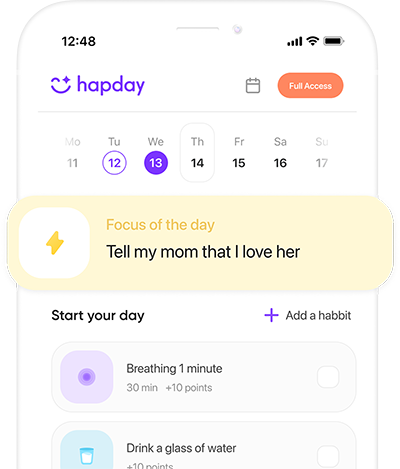
Therapy stands out as a powerful tool. Cognitive Behavioral Therapy (CBT) and Eye Movement Desensitization and Reprocessing (EMDR) seek to restructure negative thought patterns and reprocess trauma in a healthier light. Picture those late-night overthinking episodes; that’s where consistent therapy makes a difference. For those hindered by cost or time, digital alternatives like Hapday—an AI Life Coach app—provide round-the-clock support, a lifeline in solitary moments.
Mindfulness and Meditation: Calming the Neural Storm
Mindfulness helps reconnect mind and body. Research confirms that it alleviates PTSD symptoms by improving emotional regulation and bodily awareness. Simple routines, like morning deep breathing or jotting down gratitude entries at night, can become anchors. Try meditation apps to ease you in gently.
Engaging with Safe Relationships: The Healing Power of Connection
Nurturing a web of positive relations counters trauma’s isolation. The quantity of connections isn’t pivotal; the quality is. Take Lori, 32, who found comfort in a book club, bonding over tales echoing her experiences.
Redefining Your Life Narrative
Drafting a life narrative lets you make sense of the past and shape the future. For Maya, writing a memoir became a cathartic release, not for the world but herself—a ritual of letting go.
Imagining New Possibilities
Rewriting your story includes dreaming up new potential aligned with your values. Maybe it’s a new hobby, a career shift, or volunteering. Each venture fortifies the belief that your story continues—with you at the helm.
Nurturing Your Inner Child
Trauma often etches scars on our “inner child”—the part of us teeming with youthful delights and pains. Reparenting means lavishing this child with love that might have been absent. Programs like Hapday’s inner-child healing guide you in reconciling with this neglected piece of yourself.
Building a Resilient Future
So, how do you forge resilience? Confronting trauma not only reworks past narratives but also cements a future steeped in strength. Experts argue resilience isn’t innate; it’s a skill nurtured by perseverance. Establishing routines that bolster well-being—exercise, diet, rest—can provide invaluable grounding.
Taking Action with Empowerment
Escaping childhood trauma’s chain is a daunting, sometimes lifelong trek. It demands grit, resilience, and self-forgiveness. Therapy, mindfulness, and nurturing connections are allies on this path.
And equipped with the right tools? That’s when real transformation occurs. If self-awareness and empowering habits are your goals, consider trying Hapday. With 24/7 coaching and evidence-based programs, it might just be the ally you need. For those curious, visit Hapday.app to see how it could bolster your journey.
The Bottom Line
Escaping childhood trauma’s chain is a daunting, sometimes lifelong trek. It demands grit, resilience, and self-forgiveness. Therapy, mindfulness, and nurturing connections are allies on this path.
And equipped with the right tools? That’s when real transformation occurs. If self-awareness and empowering habits are your goals, consider trying Hapday. With 24/7 coaching and evidence-based programs, it might just be the ally you need. For those curious, visit Hapday.app to see how it could bolster your journey.
References:
– American Psychological Association
– CDC
– Harvard
– NIH
– Mayo Clinic