



Introduction
The night Maya’s apartment went quiet after her breakup, resilience didn’t feel like a muscle—it felt like a myth. She scrolled, stared at the ceiling, and wished for a manual on how to hold herself together. What finally helped wasn’t a single quote or a perfect routine. It was learning to speak to herself—and ask others to speak to her—in very specific ways. Think of it as learning the 7 love languages for resilience: not just for romance, but as daily, science-backed practices that steady your mind and body when life gets loud.
Here’s what we know from research: resilience is learnable, and it grows through connection, meaning, and healthy habits. The American Psychological Association has been plain about this for years—resilience isn’t an all-or-nothing trait; it’s a process shaped through skills like reframing thoughts, pursuing meaningful goals, and caring for your body (APA). Social connection, in particular, acts like a buffer. The CDC’s data on loneliness and isolation link them to worse health outcomes, including higher risks of heart disease and dementia (CDC). That echoes what the Harvard Study of Adult Development keeps finding: warm relationships predict long-term health and happiness (Harvard Gazette). In 2023, the U.S. Surgeon General went so far as to call loneliness an epidemic. I don’t think that’s hyperbole.
The idea here isn’t to “fix” you. It’s to turn the 7 love languages into a practical resilience toolkit—so you can ask for and give the kind of support that actually soothes your nervous system and strengthens your hope.
Table of Contents
- What We Mean by the 7 Love Languages for Resilience
- 1) Words of Affirmation
- 2) Acts of Service
- 3) Quality Time
- 4) Physical Touch
- 5) Receiving Gifts
- 6) Play and Laughter
- 7) Shared Purpose and Rituals
- Putting Your Plan Together
- If This Sounds Familiar…
- What to Say to the People Who Love You
- If You’re Supporting Someone Else
- When Resilience Wobbles
- Two Final Scripts for Your Phone
- Summary and Next Step
- The Bottom Line
- References
Key Takeaways
- Resilience is learnable and grows through supportive relationships, meaningful goals, and body-care habits.
- The 7 love languages can be used as practical, science-informed levers to regulate stress and restore hope.
- Start with two languages, keep practices tiny and specific, and iterate based on what calms you fastest.
- Ask for the exact support you need today; concrete, time-bound requests help people show up well.
- Play, safe touch, and rituals change physiology—not just mood—helping you return to center.
What We Mean by the 7 Love Languages for Resilience
- Words of Affirmation: evidence-based self-talk and encouragement that can turn down stress reactivity.
- Acts of Service: concrete help that lightens cognitive load and decision fatigue.
- Quality Time: sustained presence—alone and with others—that co-regulates your system.
- Physical Touch: safe, nourishing touch that downshifts stress physiology.
- Receiving Gifts: small, meaningful tokens that cue gratitude, continuity, and security.
- Play and Laughter: moments that reset tension and stretch emotional flexibility.
- Shared Purpose and Rituals: aligning around what matters so challenges feel meaningful, not random.
You might find that one or two love languages land harder when you’re under strain. That’s expected. The point is to learn how to dose yourself—and let others dose you—in the language that keeps you steady.
1) Words of Affirmation: speaking to yourself like someone worth rooting for
Why it works: Stress narrows attention to threat. It also sharpens the inner critic. Guidance from the Mayo Clinic shows that reframing thoughts can reduce stress and improve coping; the aim isn’t rose-colored thinking, it’s accuracy with kindness (Mayo Clinic). Words of affirmation function like cognitive first aid—quick interventions that stop a spiral before it accelerates.
“Resilience isn’t pretending everything is fine. It’s talking to yourself in a way that keeps you resourced enough to take the next step.”
— Dr. Lila Morgan, Licensed Clinical Psychologist
I agree; I’ve seen a grounded sentence change the temperature in a room.
How to practice:
- Create “cope cards.” Write three statements you trust even on bad days: I can do hard things in small steps. This feeling is real, and it will shift. I’m allowed to ask for help.
- Borrow credible scripts. Try: This is difficult and I’m not alone—humans go through things like this, and it hurts. Then pair it with one doable action.
- Ask for precise affirmations. Tell a friend, “Tonight I need encouragement about my progress, not advice.”
Real-life example: When Maya, 28, felt panic rise before court during her divorce, she set a two-minute timer, read her cope card aloud, and texted a friend: “Can you remind me I’ve already survived the hardest part?” That single exchange slowed her breath enough to walk in.
If you tend to ruminate at odd hours, support in the moment helps. An AI coach like Hapday lets you practice compassionate self-talk at 2 a.m., work through spirals, and leave with one concrete next step—no waiting for an appointment. Is it perfect? No. But for some, it’s better than nothing at 2 a.m.
2) Acts of Service: lowering your load so your brain can recover
Why it works: Stress is expensive. It consumes executive function—planning, memory, judgment—exactly when you need them most. The APA’s guidance on resilience emphasizes realistic goals and decisive action; tangible help makes those next steps possible when energy runs thin (APA). My view: practical aid beats pep talks nine times out of ten.
How to practice:
- Make a micro-ask list. Pre-write three tiny requests you can text without guilt: “Could you send me your dinner go-to for no-energy nights?” “Can you sit with me on FaceTime while I clean the sink?” “Can you check on me tomorrow at 10?”
- Trade services. Start a two-way swap: “I’ll edit your resume; can you walk my dog Thursday?”
- Automate the boring. Set recurring grocery orders or calendar prompts for medication so your future self doesn’t have to think.
Case study: Jordan, 31, navigating layoffs, asked a coworker, “Can you gut-check my email drafts this week?” That 10-minute favor prevented five hours of spinning.
3) Quality Time: presence that calms your nervous system
Why it works: Co-regulation is not a soft concept—it’s physiology. Humans steady one another’s nervous systems. That’s part of why long-term relationship warmth predicts health outcomes in the Harvard study (Harvard Gazette). Solo presence works too: mindfulness reduces rumination and stress reactivity (NCCIH).
How to practice:
- Schedule “resilience dates.” Thirty minutes of protected time with someone who helps you feel safe—no agenda, no multitasking. If you’re solo, make it a quiet walk or phone-free tea.
- Use the porch rule. Sit side-by-side for 10 minutes with a partner or friend; look at a neutral view, not each other. Let conversation arrive on its own.
- Timebox worry. Set 10 minutes to write every fear. When the timer ends, return to the body: name five things you see, four you feel, three you hear.
“People think quality time means depth. In a stress cycle, quality time means predictability and attention. The magic is in feeling chosen, even for a small pocket of time.”
— Jamal Ortiz, LMFT
I’d add: consistency beats intensity here.
4) Physical Touch: soothing your physiology with safe contact
Why it works: Supportive touch can lower stress markers and stabilize heart rate and blood pressure. Harvard Health has summarized research tying healthy touch to improved well-being, while massage therapy shows benefits for pain and anxiety in some studies (NCCIH). The operative word is safe—consensual, wanted contact your body can actually relax into.
How to practice:
- Create a “touch menu.” From self-hug and hand over heart to a weighted blanket, neck wrap, or gentle self-massage. Choose what feels right today.
- Ask for specifics. “Could you squeeze my hand for 30 seconds?” Clear, time-bound asks make it easier for loved ones to show up well.
- Pet therapy counts. Ten minutes stroking a pet can be profoundly regulating.
When Priya, 27, felt grief spikes in the afternoon, she kept a heated wrap at her desk. Two minutes on her shoulders while reading a kind text often helped her downshift. Touch is an understated tool; it changes the story your body tells itself.
5) Receiving Gifts: anchors of care and gratitude
Why it works: Thoughtful, small gifts can become steadying cues—physical reminders that you’re held in mind. Gratitude research highlighted by Harvard Health suggests that noticing and naming appreciation can lift mood and, over time, may improve sleep and health behaviors (Harvard Health). A note tucked into a book, a pebble from a beach walk, a packet of tea—these aren’t trinkets; they’re anchors.
How to practice:
- Build a “kindness cache.” Keep a box with notes, printouts of encouraging texts, photos, or ticket stubs. Touch it when anxiety rises.
- Set a symbol. Wear a bracelet you associate with courage, or place a stone in your pocket to hold during hard calls.
- Ask for mementos. Tell a friend, “If you see a postcard that reminds you of me, would you mail it?” The point is meaning, not money.
One opinion, plainly stated: the right object, chosen with care, can speak longer than a paragraph.
6) Play and Laughter: pressure valves that reset tension
Why it works: Laughter changes biochemistry. It stimulates organs, activates and then cools the stress response, and can unclench tense muscles—with potential immune and mood benefits (Mayo Clinic). Play expands your options. It interrupts tunnel vision, which is resilience by another name.
How to practice:
- Make a “ridiculous file.” Save 30-second videos, memes, or inside-joke audio for quick relief. Let yourself actually laugh out loud.
- Schedule micro-play. Two minutes of doodling, dancing in your kitchen, or a silly round of charades after dinner.
- Laughter swap. Text a friend weekly: “Send me the most chaotic pet video you saw.” A simple ritual that bridges hard weeks.
“When we play, we remember we have choices. That sense of agency is the backbone of resilience.”
— Dr. Kevin Rhodes, PhD, Behavioral Scientist and Resilience Coach
I’d argue play is an underrated intervention in adult life.
7) Shared Purpose and Rituals: making stress feel meaningful
Why it works: Purpose reframes struggle as part of a valued path. The APA’s roadmap to resilience highlights moving toward goals, maintaining perspective, and caring for your body—each easier when connected to your “why” (APA). Rituals reinforce this by offering predictable anchors during uncertainty, reducing cognitive load. The Guardian reported in 2021 on how small, repeated acts provided ballast during the pandemic; that rings true beyond crisis months.
How to practice:
- Write a one-sentence why. “I’m learning to set boundaries because I want energy for my art and my people.” Revisit it weekly.
- Create micro-rituals. Monday morning cocoa, Friday gratitude text, a candle lit before tough emails. Rituals tell your brain, “We’ve been here; we know what to do.”
- Align with others. Invite a friend or partner into a shared ritual—Sunday planning, midweek check-ins—so purpose becomes communal.
My bias here: rituals are a form of quiet leadership. They model steadiness when words fail.
Putting Your 7 Love Languages Plan Together
You don’t have to master all seven. Choose two that feel like oxygen right now. Make them tiny and specific. Then layer a third once you feel steady.
Try this flow:
- Scan your day. Where do you feel your body clench?
- Pick the matching language. If your mind spirals, that’s Words of Affirmation. If chores drown you, it’s Acts of Service. If you’re wired and restless, try Physical Touch or Play.
- Script the how. Write the exact text you’ll send, the object you’ll reach for, the 2-minute ritual you’ll do.
- Track what works. Resilience is a feedback loop.
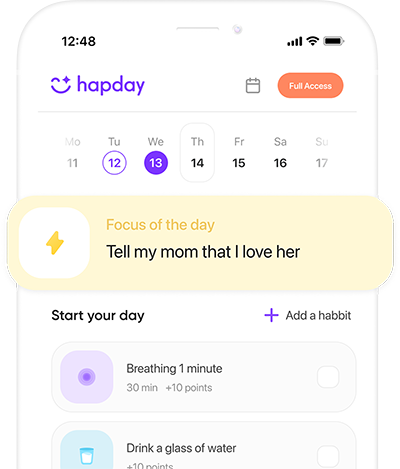
Platforms like Hapday, which over 3 million people now use for daily mental health coaching, can help you experiment with these micro-strategies and notice patterns—its mood and habit tracking makes it easier to see which “language” calms you fastest.
If This Sounds Familiar…
You might be feeling like you’ve tried it all, or like asking for help is a burden. Resilience is sometimes framed as toughness, but it’s actually responsiveness. It’s giving yourself options—seven different ways to return to center—so you don’t have to rely on willpower alone.
What to Say to the People Who Love You
- “My mind is overactive today. One voice note telling me what I’ve done right this week would help.”
- “Could we sit on the couch and not talk for 15 minutes? That would be quality time for me.”
- “I need a hug with slow breathing—30 seconds, then we can debrief.”
- “I’m building a cache of tokens that remind me I’m loved. If something small makes you think of me, would you share it?”
- “My goal is to go to bed kinder than I woke up. Can you ask me at 9 p.m. what helped today?”
If You’re Supporting Someone Else
- Ask for their language today, not in general. Stress changes the answer.
- Offer two choices: “Vent or solutions?” “Walk or humor break?” Choices are regulating.
- Keep it concrete and time-bound. “I can drop dinner in 20 minutes and pick up the dishes tomorrow.”
When Resilience Wobbles
You won’t do this perfectly. That’s not the assignment. The assignment is noticing what steadies you and repeating it with a little less friction each time. On some days, resilience is a soaring arc. On others, it’s simply reading a sentence you wrote to yourself last week and believing it for ten seconds. That counts. It always has.
Two Final Scripts for Your Phone
- Words of Affirmation (self): This is hard and I’m still worthy. What’s one action that moves me 1%?
- Acts of Service (other): Today’s heavy. Could you choose one small thing to take off my plate?
Summary and Next Step
Resilience grows when love moves from vague support to specific actions—spoken, tangible, playful, and purposeful. Start with two of the 7 love languages, keep them tiny, and repeat what works. If you want real support doing this day to day, consider a coach in your pocket. Hapday (hapday.app) offers 24/7 AI sessions and habit tracking to help you build the practices that actually stick.
The Bottom Line
You don’t have to be tougher—you can be better resourced. Pick two love languages, keep the actions small, ask for what you need today, and let consistency do the heavy lifting. That’s resilience you can practice, not perfection you have to prove.
References
- American Psychological Association — Building your resilience: https://www.apa.org/topics/resilience/building-your-resilience
- Centers for Disease Control and Prevention — Loneliness and Social Isolation Linked to Serious Health Conditions: https://www.cdc.gov/aging/publications/features/lonely-older-adults.html
- Harvard Gazette — Over nearly 80 years, Harvard study has been showing that embracing community helps us live longer, and be happier: https://news.harvard.edu/gazette/story/2017/04/over-nearly-80-years-harvard-study-has-been-showing-that-embracing-community-helps-us-live-longer-and-be-happier/
- Harvard Health Publishing — Giving thanks can make you happier: https://www.health.harvard.edu/healthbeat/giving-thanks-can-make-you-happier
- Mayo Clinic — Positive thinking: Stop negative self-talk to reduce stress: https://www.mayoclinic.org/healthy-lifestyle/stress-management/in-depth/positive-thinking/art-20043950
- Mayo Clinic — Stress relief from laughter? It’s no joke: https://www.mayoclinic.org/healthy-lifestyle/stress-management/in-depth/stress-relief/art-20044456
- National Center for Complementary and Integrative Health — Meditation and Mindfulness: What You Need To Know: https://www.nccih.nih.gov/health/meditation-and-mindfulness-what-you-need-to-know
- National Center for Complementary and Integrative Health — Massage Therapy: What You Need To Know: https://www.nccih.nih.gov/health/massage-therapy-what-you-need-to-know
- U.S. Surgeon General — Our Epidemic of Loneliness and Isolation: The U.S. Surgeon General’s Advisory, 2023
- The Guardian — “Rituals helped us cope during the pandemic,” reported 2021 news coverage on everyday practices and mental health