



Guilt can be a moral compass—or a mental quicksand. How to Rewire Guilt with Meditation isn’t about erasing your conscience; it’s about transforming sticky, looping guilt into clear signals that help you repair, learn, and move forward. The data are not vague here. Across the past two decades, studies have shown that targeted mindfulness and compassion practices reduce rumination, settle the body’s threat responses, and nudge us toward prosocial action—the healthy core of guilt. In my view, that combination is the rare blend of humane and effective we need more of.
Table of Contents
- Why guilt feels so heavy (and how the brain keeps it alive)
- How to Rewire Guilt with Meditation: What the brain needs
- How to Rewire Guilt with Meditation: A 10-minute practice you can start today
- Micro-practices to Rewire Guilt with Meditation (for busy days)
- Troubleshooting when meditation backfires
- Make it stick: habit design for rewiring guilt
- What “success” looks like
- Closing summary and CTA
- References
Why guilt feels so heavy (and how the brain keeps it alive)
- Guilt vs. shame: Guilt says “I did something wrong,” while shame says “I am wrong.” Decades of research indicate guilt is more likely to motivate repair and empathy, whereas shame predicts withdrawal and defensiveness (Tangney, Stuewig, & Mashek, 2007). Anyone who has tried to apologize from a place of shame knows how brittle it sounds—and how quickly it collapses.
- Rumination fuels guilt: Repetitively replaying mistakes predicts more depression and anxiety (Nolen-Hoeksema et al., 2008). The brain’s default mode network (DMN) helps maintain that loop; long-time meditators show quieter DMN activity (Brewer et al., 2011). A 2021 Harvard-affiliated overview noted similar patterns in clinical groups, which tracks with what therapists have reported for years.
- Stress physiology: When guilt flips into threat mode, the amygdala and sympathetic nervous system fire up, narrowing attention and making problem-solving harder. Mindfulness training has been linked with reduced amygdala reactivity to emotional stimuli (Desbordes et al., 2012). My take: until the body is steadier, insight rarely sticks.
How to Rewire Guilt with Meditation: What the brain needs
Meditation changes both attention and attitude. Attention training interrupts rumination; acceptance and compassion reduce self-criticism so you can engage in repair rather then retreat.
- Mindfulness reduces distress and rumination: Randomized trials show mindfulness meditation lowers distress and rumination compared with relaxation (Jain et al., 2007); pooled analyses find moderate improvements in anxiety and depression (Goyal et al., 2014; Goldberg et al., 2018). Not a cure-all, but a reliable lever.
- Compassion practice softens self-attack while increasing motivation to make amends: Meta-analyses report significant reductions in depression, anxiety, and self-criticism (Kirby et al., 2017; Ferrari et al., 2019). In plain terms, you become kinder and more accountable at once—an underappreciated pairing.
- Breathing at ~6 breaths/min supports emotion regulation via heart-rate variability (HRV), a marker of flexible nervous system balance (Lehrer & Gevirtz, 2014). Think of it as tuning the body’s metronome before you play the hard piece.
Image alt: How to Rewire Guilt with Meditation
How to Rewire Guilt with Meditation: A 10-minute practice you can start today
Use this flow when guilt spikes—or daily to build new wiring. Small, consistent sessions tend to outperform heroic one-offs. The Guardian reported in 2020 that quick, sincere repairs land better then grand gestures; practice makes those quick moves possible.
-
1) Check the signal (1 minute)
- Ask: Is this guilt helpful (points to a repairable action) or harmful (global self-attack, vague, historic)? If helpful, commit to a repair step. If harmful, shift into compassion work. My bias: clarity first, always.
-
2) Ground the body (2 minutes)
- Breathe in 4 seconds, out 6 seconds. Feel feet and seat. Research on paced breathing shows improved HRV and calmer arousal (Lehrer & Gevirtz, 2014). You are resetting physiology so thinking can rejoin the room.
-
3) Mindful observation (3 minutes)
- Label what’s present: “tightness in chest,” “thought: I blew it.” Not “I am bad,” but “I’m noticing the thought I’m bad.” This separates you from rumination (Jain et al., 2007).
- Gently redirect attention to breath each time the loop returns. Repetition is the rep that rewires DMN patterns (Brewer et al., 2011). It feels ordinary while it’s happening—change usually does.
-
4) Self-compassion break (2 minutes)
Use Kristin Neff’s three steps:
- Mindfulness: “This is a moment of guilt.”
- Common humanity: “Everyone makes mistakes; I’m not alone.”
- Kindness: Hand on heart; say a phrase like, “May I respond wisely.” Compassion training reliably reduces self-criticism and negative affect (Ferrari et al., 2019; Kirby et al., 2017). If anything deserves a gentle tone, it’s this.
-
5) Wise action (2 minutes)
- If the guilt is valid, pick one repair: apologize, clarify, repay, or learn. Form an implementation intention: “If it’s 9 a.m., then I’ll send the apology email.”
- Such “if-then” plans significantly increase follow-through (Gollwitzer & Sheeran, 2006). Accountability without drama is a quiet superpower.
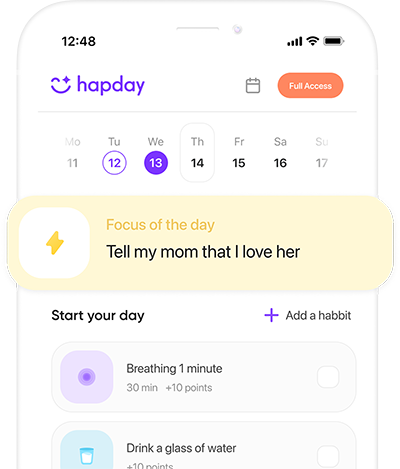
Tool-among-tools note: If rumination spikes late at night, an AI coach like Hapday can walk you through paced breathing and a self-compassion break on demand, plus track patterns that keep guilt looping—useful when you can’t wait for an appointment. Use tech as a bridge, not a crutch; that’s my only caveat.
Micro-practices to Rewire Guilt with Meditation (for busy days)
- The 60-second reset: 6 slow breaths, label one feeling and one need, choose one tiny repair (DM a clarification; schedule a conversation). It’s humble, and it works.
- Compassion taps: Hand to chest while repeating, “I made a mistake, and I can make a move.” Somatic cues can reduce threat physiology and enable perspective-taking. It’s the body saying, Stay.
- Loving-kindness burst: For 1 minute, silently offer, “May I be patient; may they be at ease.” Brief compassion practice can reduce anger and increase warmth (Kirby et al., 2017). A minute is enough to shift a tone.
Troubleshooting when meditation backfires
- “Meditation makes me relive everything.” Try eyes open, shorter sets (2–3 minutes), or anchor in sensation-heavy practices (hands in warm water) before breath work. Trauma-sensitive pacing matters. Better to go slower than to quit.
- “I just feel numb or sleepy.” Increase breathing ratio to 3 in/5 out, stand or walk mindfully, or splash cool water on your face first to raise alertness. Drowsiness is information—not failure.
- “I keep judging myself for not doing it right.” That’s the work. When judgment appears, label it kindly and return. Self-judgment decreasing over time is itself a sign of rewiring (Ferrari et al., 2019). Progress is rarely linear; it’s still progress.
Make it stick: habit design for rewiring guilt
- Anchor: Pair the 10-minute sequence with an existing cue: “After brushing teeth at night, I meditate.” Habit stacking increases consistency. I’d rather see five quiet nights than one perfect Sunday.
- Track: Note triggers, practice length, and one repair step you took. Data fosters insight and reduces all-or-nothing thinking. A simple notes app is enough.
- Sleep: Guilt loves 2 a.m. rumination, which worsens sleep and next-day mood. Mindfulness-based approaches improve insomnia outcomes (Ong et al., 2014). Prioritize a calming pre-sleep ritual and a very short compassion break in bed if needed. Protect sleep as if it’s part of the intervention—because it is.
What “success” looks like
- Faster recovery time after mistakes
- Fewer hours lost to rumination; more specific repairs taken
- Softer self-talk without losing accountability
- Greater capacity to hear feedback without collapse or defensiveness
In my experience, when these show up, people start trusting themselves again.
Closing summary and CTA
Rewiring guilt isn’t about forgetting; it’s about transforming. Practice the breath-mindfulness-compassion-action sequence daily and you’ll feel the shift—first as a little more space, then as steadier choices. If you want support turning How to Rewire Guilt with Meditation into a real habit, consider checking out Hapday for 24/7 AI coaching and progress tracking tailored to rumination and repair. A modest move today, a lighter mind tomorrow.
References
- Tangney, J. P., Stuewig, J., & Mashek, D. J. (2007). Moral emotions and moral behavior. Annual Review of Psychology. https://doi.org/10.1146/annurev.psych.56.091103.070145
- Brewer, J. A., et al. (2011). Meditation experience is associated with differences in default mode network activity. PNAS. https://www.pnas.org/doi/10.1073/pnas.1112029108
- Desbordes, G., et al. (2012). Effects of mindful-attention training on amygdala response to emotional stimuli. Frontiers in Human Neuroscience. https://www.frontiersin.org/articles/10.3389/fnhum.2012.00292/full
- Jain, S., et al. (2007). A randomized controlled trial of mindfulness meditation versus relaxation training. Annals of Behavioral Medicine. https://doi.org/10.1007/BF02873466
- Goyal, M., et al. (2014). Meditation programs for psychological stress and well-being: A systematic review and meta-analysis. JAMA Internal Medicine. https://jamanetwork.com/journals/jamainternalmedicine/fullarticle/1809754
- Goldberg, S. B., et al. (2018). Mindfulness-based interventions for psychiatric disorders: A systematic review and meta-analysis. Clinical Psychology Review. https://doi.org/10.1016/j.cpr.2018.06.008
- Kirby, J. N., et al. (2017). Compassion interventions: A systematic review and meta-analysis. Mindfulness. https://doi.org/10.1007/s12671-016-0715-0
- Ferrari, M., et al. (2019). Self-compassion interventions and psychosocial outcomes: A meta-analysis. Mindfulness. https://doi.org/10.1007/s12671-018-1037-6
- Lehrer, P. M., & Gevirtz, R. (2014). Heart rate variability biofeedback: How and why does it work? Frontiers in Psychology. https://www.frontiersin.org/articles/10.3389/fpsyg.2014.00756/full
- Gollwitzer, P. M., & Sheeran, P. (2006). Implementation intentions and goal achievement. Advances in Experimental Social Psychology. https://doi.org/10.1016/S0065-2601(06)38002-1
- Ong, J. C., et al. (2014). Mindfulness meditation for insomnia: A meta-analysis of randomized controlled trials. Sleep Medicine Clinics. https://doi.org/10.1016/j.jsmc.2014.08.001
- Nolen-Hoeksema, S., et al. (2008). Ruminative coping and the onset of depression and anxiety. Journal of Abnormal Psychology. https://doi.org/10.1037/0021-843X.110.3.504