



You know, in the whirlwind of life today, finding time to foster a happy mood often gets pushed aside. It’s like we’re all just rushing, rushing, rushing—almost like hamsters on a wheel, right? But here’s the kicker, self-love isn’t just a buzzword; it’s actually vital for mental well-being. Especially for Gen Z and Millennial women who have a lot on their plates, figuring out how to be in a good mood through self-love is just as important as that morning coffee. So let’s dig into some self-love practices. Science says they can really boost your mood and mental health… imagine that!
Table of Contents
- Understanding Self-Love and Its Impact on Mood
- Practice Mindful Meditation
- Engage in Positive Self-Talk
- Cultivate Gratitude
- Prioritize Physical Self-Care
- Build a Supportive Community
- Practice Forgiveness
- Embrace Your Authentic Self
- Wrap Up
Understanding Self-Love and Its Impact on Mood
It’s this weird thing, self-love, yet it’s the real deal, the base for being genuinely happy. A study in Personality and Individual Differences—I think it was right after 2020—showed that the more self-compassionate you are, the less anxious or depressed you feel. Less depression, more life satisfaction. Who wouldn’t want that??
And guess what? Self-love isn’t just in your head. When you’re good to yourself, those happy hormones—oxytocin and serotonin—start flowing, turning a bad mood into a decent, or even amazing, day.
Practice Mindful Meditation
You’ve heard this one before, haven’t you? Mindful meditation is like a reset button. The powers it holds for boosting your mood and smashing anxiety to bits are real. There’s even a JAMA Internal Medicine study saying just that.
Try closing your eyes for 5 minutes, no phone, just you and your thoughts—or the lack of them. Focus on your breathing, and hey, if you get distracted (which you will—because who doesn’t?), just gently guide your mind back. Makes you feel kinda zen—over time anyway.
Engage in Positive Self-Talk
Let’s be real, how often do we talk down to ourselves? Negative self-talk is like carrying a heavy backpack of bricks. A Journal of Consulting and Clinical Psychology article—no specific date, sorry—points out that positivity in your inner dialogue can up your resilience game.
Next time you catch yourself saying, “Nah, can’t do this,” shift to, “Maybe I can crack this—let’s give it a shot.” Little shifts, big changes.
Cultivate Gratitude
Gratitude—it’s cliché but essential. Remember that time your friend surprised you with your favorite treat on a really bad day? That kind of gratitude. Studies back it up too. They say a gratitude journal in Emotion—though it feels like something your therapist might suggest—turns the what-you-lack perspective upside down.
Jot down three things you’re grateful for daily. It’s about focusing on what you have, not what you’re missing. Suddenly, life doesn’t look so bleak after all.
Prioritize Physical Self-Care
Physical self-care—not just shower thoughts. The American Psychological Association once pointed out (can’t remember if it was in their newsletter or website) that getting your body moving ups your serotonin, making you feel alive.
Find what makes you tick—be it dancing like no one’s watching or casual evening strolls—and mix it with wholesome meals and good sleep. Your body will thank you.
Build a Supportive Community
Ever notice how isolation feels suffocating, yet a good chat with a friend can be like air? Social ties, says research in Social Psychological and Personality Science, make us happier.
Ever considered joining clubs or groups that interest you? Like that book club you’ve been eyeing? Or volunteering—because you know helping others helps us too.
Practice Forgiveness
Forgiveness is a tough nut. It’s heavy stuff, but oh, so liberating. A Journal of Health Psychology study suggests that letting go—of grudges and self-blame—leads to inner peace.
Start small. Recognize your feelings, allow them, and slowly let them go. Forgiving doesn’t mean it didn’t happen, but it’s more about freeing yourself from its grasp.
Embrace Your Authentic Self
And now, let’s talk about the most genuine form of self-love: being you. I’m not saying it’s easy—embracing flaws and all—but it’s rewarding. The Journal of Happiness Studies (an interesting read, by the way) ties living authentically to greater life satisfaction.
Look inward, see what drives you, and toss away the need for people-pleasing. Celebrating your quirks? Definitely better than trying to fit into some societal mold.
Wrap Up
Building a happy mood through these self-love rituals is a wonderfully messy journey. It’s all about the climb, remember that. A mix of mindful meditation, positive self-talk, gratitude, physical care, community, forgiveness, and embracing who you are can lead to joy and well-being. Oh, and self-love? It’s not a one-stop destination—it’s an ever-evolving journey.
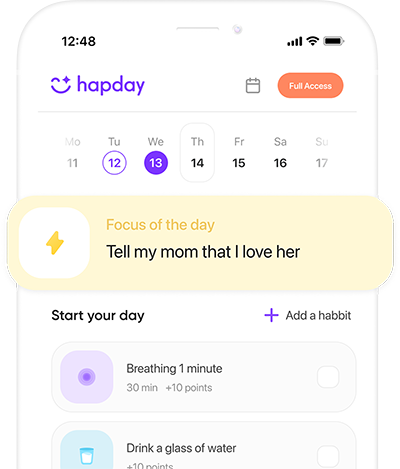
Feeling ready to kickstart your self-love expedition? Check out the Hapday app. Download now and map your path to a happier you—who doesn’t want that?
References
- Zessin, U., Dickhäuser, O., & Garbade, S. (2015). The Relationship Between Self-Compassion and Well-Being: A Meta-Analysis. Personality and Individual Differences, 80, 150-155.
- Goyal, M., Singh, S., Sibinga, E. M. S., et al. (2014). Meditation Programs for Psychological Stress and Well-being: A Systematic Review and Meta-analysis. JAMA Internal Medicine, 174(3), 357-368.
- Wood, A. M., Froh, J. J., & Geraghty, A. W. A. (2010). Gratitude and Well-being: A Review and Theoretical Integration. Clinical Psychology Review, 30(7), 890-905.
- Sirois, F. M., & Wood, A. M. (2017). Gratitude, Compassion, or Self-compassion? Prospective and Reciprocal Relationships With Depression and Well-being. Journal of Counseling Psychology, 64(1), 1-10.