



Table of Contents
- The Roots of Guilt Post-Trauma
- Confronting the Myth of Self-Blame
- Embracing Emotional Release and Expression
- Seeking Support: You’re Not Alone in This Process
- Reframing the Narrative: Cognitive Behavioral Approach
- Building Resilience Through Self-Care
- Moving Forward with Dignity and Strength
Picture this: You’re like Maya, a 28-year-old graphic designer. By day, she’s creating whimsical worlds for children’s books. But when night falls, her thoughts spiral into guilt over a car crash months ago—a crash she survived, though she’s haunted by the relentless “what-ifs.” This shadow, guilt, clings stubbornly. Sound familiar? Maybe you’re wrestling with something similar. Or maybe it’s a different trauma, but the common thread remains: a distressingly pervasive sense of unjustified responsibility.
It’s a heavy weight, this trauma-induced guilt, convincing you that you somehow hold the blame for events where, logically, you don’t. In this piece, we’ll delve into the intricate layers of this emotion, explore healing strategies, and gather insights from seasoned experts. You deserve a life unfettered by unwarranted guilt. So let’s walk this journey. Together.
The Roots of Guilt Post-Trauma
Guilt after trauma wears many faces—survivor’s guilt, self-blame, misplaced responsibility. A 2008 study in the Journal of Traumatic Stress found that 22% of trauma survivors endure this burden.
“Guilt becomes a way to maintain control over chaos. By holding ourselves accountable, we trick ourselves into thinking we could’ve changed the outcome. But really, it’s often just a mirage.”
— Dr. Sarah Chen, Clinical Psychologist
When traumas are revisited, it’s common to judge every decision, every hesitation—like rewinding a tape endlessly. This intense self-scrutiny, aimed at reclaiming control, ironically, tends to distort reality and amplify guilt.
Confronting the Myth of Self-Blame
How do you tackle something as persistent as guilt? It often arises from what Dr. Aaron Beck, a cognitive behavioral therapy pioneer, termed “cognitive distortions”—biases in thinking. Personalization is one such distortion, leading to unwarranted self-blame.
Take Maya. Pre-crash, she hesitated at a light. “If only I’d turned sooner,” she thinks, “the accident might’ve been avoided.” But what about the other driver’s actions? The light’s timing? The weather? None of these were hers to control.
Recognizing these mental distortions is the first step. Seeing how your mind exaggerates your role in uncontrollable events can truly be liberating.
Embracing Emotional Release and Expression
It’s okay if confronting these feelings seems terrifying. Safe, constructive outlets for guilt expression hold healing power. Art, writing, even honest self-conversations can be transformative.
“Write raw letters—to yourself or others involved. Keep them, share them, or destroy them. It’s about giving shape to feelings that feel otherwise nebulous and suffocating.”
— Dr. Emily Storm, Trauma Therapist
Consider Alex, a 35-year-old teacher surviving a natural disaster. Initially, he felt guilty for making it out when neighbors didn’t. But as he painted abstract representations of his emotions, a new sense of relief began to unfold.
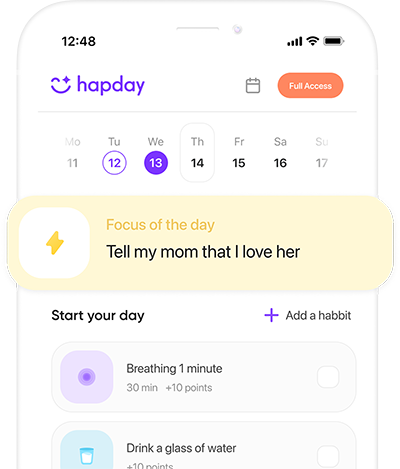
Mindfulness can also help keep you grounded during restless moments. Imagine it’s 2 a.m., and your mind just won’t switch off. Platforms like Hapday, offering 24/7 AI coaching, let you navigate those spiraling thoughts immediately. Over 3 million rely on tools like these for immediate solace.
Seeking Support: You’re Not Alone in This Process
You don’t have to journey through guilt alone.
“Sharing with a trusted friend, support group, or therapist brings fresh perspectives and eases isolation.”
— Dr. Lilian Kerr, Therapist
Research in Clinical Psychology & Psychotherapy (2019) noted a significant decrease in guilt among group therapy participants. The collective experience often sheds light on trauma aspects we hadn’t considered while nurturing self-compassion.
Therapy, though, isn’t the only path. Journaling, meditation, life coaching apps like Hapday can support a structured routine and exercises in self-kindness. Particularly, Hapday’s inner-child program delves into how past narratives shape current views. The path through guilt becomes less daunting.
Reframing the Narrative: Cognitive Behavioral Approach
Changing how you view the past involves reshaping its narrative. Cognitive Behavioral Therapy (CBT) provides practical methods for rewriting these stories. Counteract self-defeating beliefs with hard evidence.
Maya, for instance, keeps a thought journal. Each guilt-ridden thought is captured and countered with rationality. Over time, she reframes her understanding of her actions.
“Use CBT to dissect guilt moments. Identify feelings, scrutinize their validity, and reform the narrative with facts.”
— Dr. John Matthews, Trauma Recovery Expert
This empowers you to move from victimhood to surviving with strength.
Building Resilience Through Self-Care
The power of self-care in battling guilt is often overlooked. Yet it’s fundamental to emotional resilience. Engaging in well-being activities helps restore equilibrium.
Simple actions—regular sleep, yoga, nature walks—can regulate mood and stress. The American Psychological Association revealed in 2018 that regular physical activity vastly reduces anxiety and depression symptoms, which often accompany guilt.
Self-care also requires setting personal boundaries. Know when to step back from guilt-whirling thoughts. Platforms like Hapday, with exercises and progress tracking, support your mental health alongside self-care practices.
Moving Forward with Dignity and Strength
These strategies form your path to healing, but the journey isn’t just about shedding guilt. It’s about reclaiming joy, purpose, and self-kindness. Healing’s cyclical. Guilt may return. Acknowledge, reassess, and remember—it’s okay to seek support along the way.
Breaking free from guilt post-trauma is hard but doable. Your past doesn’t dictate your future. Equip yourself with knowledge, support, and self-care. For continuous backing, tools like Hapday stand ready. Millions rely on it already. Why not explore its evidence-based coaching anytime you need it at hapday.app? Because you deserve to embrace life on your terms.
Key Takeaways
- Guilt after trauma often stems from cognitive distortions that exaggerate personal responsibility.
- Constructive emotional outlets, such as writing or art, can facilitate healing and expression.
- Seeking support from friends, groups, or therapists can provide new perspectives on your feelings.
- Using Cognitive Behavioral Therapy techniques can help reframe guilt and its narratives.
- Self-care practices are essential for building emotional resilience against trauma-induced guilt.
The Bottom Line
Healing from trauma-related guilt is a multifaceted process involving self-discovery, support, and cognitive reframing. Embrace the journey with knowledge and compassion, knowing that it’s possible to move forward with dignity and strength.
References
- Journal of Traumatic Stress
- Clinical Psychology & Psychotherapy
- American Psychological Association