



At 1:17 a.m., the house is finally quiet. You’re folded over the kitchen table, the week’s meds beaded across a pill organizer. The notes app on your phone is a thicket of appointments, insurance snags, and one reminder you keep postponing: “Text Lena back.” If you’ve muttered, “I can’t keep doing it like this,” you’re not the outlier — you’re the rule. And it’s often the moment people first hear about mental health coaching for caregivers. The term can sound sterile, almost bureaucratic. In practice, for many women in the thick of care, it turns into a working lifeline: not therapy, not a pep talk, but structured support designed to help your mind and body hold up under someone else’s needs. In my view, that distinction matters more than any label.

Table of Contents
- What Mental Health Coaching for Caregivers Actually Is
- The Science Behind Why It Helps Caregivers
- What Happens in Mental Health Coaching for Caregivers
- How Mental Health Coaching for Caregivers Differs from Therapy
- Is Mental Health Coaching for Caregivers Right for You?
- A Week Inside Mental Health Coaching for Caregivers
- Boundaries That Won’t Blow Up Your Family Chat
- The Invisible Load and How to Lighten It
- If the System Is Cracking: Signs to Pivot
- How to Choose a Coach You’ll Actually Trust
- Cost, Access, and Creative Supports
- Practical Skills You Can Try Today
- Real People, Real Adjustments
- A Quick Word on Motivation
- Closing Summary and Call to Action
- The Bottom Line
- References
Key Takeaways
- Mental health coaching translates proven skills (CBT, mindfulness, problem-solving) into daily caregiver routines.
- The focus is on actionable goals, boundary-setting, and stress reduction — not diagnosing or treating disorders.
- Structured check-ins and tiny, repeatable habits lower cognitive load and protect sleep and mood.
- Coaching can complement therapy; know when to escalate to clinical care for safety.
- Systems, scripts, and shared tools reduce the invisible load and invite reliable support.
What Mental Health Coaching for Caregivers Actually Is
Think of mental health coaching for caregivers as the place where daily emotional strain meets skills training. Collaboration over prescription. Goals you can touch, not just admire. It draws on evidence-based strategies — tools with research behind them, from cognitive behavioral techniques to problem-solving to brief mindfulness. Unlike psychotherapy, which diagnoses and treats mental health disorders, coaching concentrates on habits, thought patterns, communication, and self-care systems so you can function better now, in the middle of the week you already have.
“Caregiving compresses time and expands stress. Coaching gives you a scaffold: clear goals, micro-steps, and compassionate accountability. You learn to challenge an unhelpful thought, ask for help, renegotiate a workplace deadline — and you practice until it sticks.”
— Dr. Lena Ortiz, Licensed Clinical Psychologist
I’ve sat in on sessions where a single sentence tweak reduced a caregiver’s nightly dread; small language shifts can deliver disproportionate relief.
A typical plan in mental health coaching for caregivers includes:
- A snapshot of where your stress shows up (sleep, irritability, body aches, rumination)
- 1–3 concrete goals (sleeping 6 hours most nights, delegating one task, a 10-minute wind-down)
- Skills practice (thought reframes, boundary scripts, brief breathing routines)
- Check-ins that help you adapt the plan as life shifts
The goal isn’t to fix your loved one’s situation. It’s to steady yours — which is both practical and, yes, an ethical choice.
The Science Behind Why It Helps Caregivers
Caregiving is a public-health fact. The CDC has estimated that roughly one in five U.S. adults provides unpaid care to a family member or friend; many report higher anxiety, more depressive symptoms, and greater chronic health problems than non-caregivers. Back in 2020, that trend line sharpened as more families kept care at home, a point several primary care doctors told me they still feel. Stress biology explains part of it. Harvard Health has noted that when stress is chronic, the body’s fight-or-flight hormones stay elevated, disrupting sleep, fogging memory, and amplifying irritability. Over time, that load increases vulnerability to mood symptoms and burnout.
Here’s where the “mental” in mental health coaching earns its place. Core techniques are borrowed from well-studied therapies and translated into daily practice:
- Cognitive behavioral skills help you spot and reframe catastrophic thinking — a reliable anxiety accelerant. NIMH recognizes CBT as effective for anxiety and depression.
- Mindfulness practices reduce perceived stress and reactivity; Harvard Health has reported that mindfulness meditation may ease anxiety and improve emotional regulation.
- Structured problem-solving and boundary-setting support better time management and lighten overload; Mayo Clinic’s caregiver guidance endorses exactly these moves.
Dr. Marcus Bell, a board-certified psychiatrist who trains health coaches, told me:
“When caregivers learn to interrupt rumination, cue a two-minute breath, and ask for concrete help — ‘Can you handle Wednesday rides?’ — their nervous system gets a break. That’s not fluff; it’s physiology.”
— Dr. Marcus Bell, Board-Certified Psychiatrist
I’d argue the most radical part is its modesty: small inputs, steady dividends.
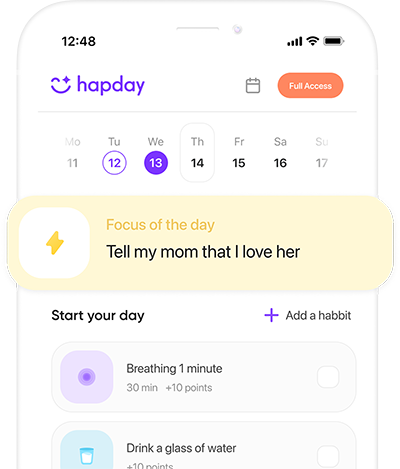
At 2 a.m., when your loved one finally sleeps and your mind won’t, an AI coach like Hapday offers 24/7 sessions so you can debrief stress in the moment rather than waiting days for an appointment. It uses evidence-based exercises and can be a budget-friendly bridge between visits with your therapist or doctor. For some, that immediacy is the difference between spiraling and sleeping.
What Happens in Mental Health Coaching for Caregivers
Picture the first session. You describe your week; the coach listens for friction points you can actually influence. Then you co-create experiments — small, testable changes. Mental health coaching for caregivers tends to follow a rhythm:
- Clarify the load: Map who needs what, when, and which tasks only you can do.
- Identify a keystone habit: One lever that improves several things at once (say, a consistent wind-down that protects sleep and curbs late-night scrolling).
- Practice a thought reframe: “If I don’t do it, it won’t be done right” becomes “Done by someone else frees me to do what only I can do.”
- Script the hard ask: A 20-second help request you can text to a sibling or friend, reducing decision fatigue.
- Create tiny recovery pockets: 60–120 second breathwork, a five-minute outside walk, or a body scan while the kettle boils.
- Build a crisis-lite plan: Three steps when overwhelmed (step out, drink water, one calming breath cycle) before revisiting a problem.
Why it works: less cognitive load. By turning coping into cues and routines, you conserve energy for care and cut down on the mental tug-of-war. The National Institute on Aging and Mayo Clinic both highlight how predictable recovery moments, support-seeking, and realistic goals protect caregivers from escalating stress. I’ve seen coaches refuse to chase perfection; that restraint, in my opinion, is an asset.
When Maya, 28, went through a divorce while caring for her mom with MS, she told her coach, “I wake up already behind.” They picked one priority: restore sleep to six hours. Over three weeks, Maya moved her last caffeine to noon, set a 10 p.m. phone curfew, and used a three-breath practice before bed. She also wrote a boundary script to shorten late-night family calls. The first time she hit five nights of six-hour sleep, she cried — not because everything was solved, but because her brain could focus again.
How Mental Health Coaching for Caregivers Differs from Therapy
- Scope: Therapy treats diagnosable conditions; coaching supports skill-building and behavior change. If you have major depression, bipolar disorder, PTSD, or suicidal thoughts, a licensed clinician should lead your care.
- Depth: Coaching looks forward and is structured around goals; therapy may explore past trauma and underlying dynamics.
- Credentials: Coaches can be trained and certified but aren’t necessarily licensed clinicians. You can absolutely use both.
Dr. Sarah Kim, a family physician who coordinates caregiver resources in her clinic, told me:
“I love when my patients pair therapy with coaching. Therapy helps heal; coaching helps implement. For overwhelmed caregivers, that combo often restores hope and momentum.”
— Dr. Sarah Kim, Family Physician
That pairing strikes me as pragmatic, not indulgent.
Is Mental Health Coaching for Caregivers Right for You?
If any of these ring true, mental health coaching for caregivers may fit:
- You feel on-edge or exhausted most days but can still complete work and caregiving tasks.
- You want better sleep, clearer boundaries, and less second-guessing.
- You’re not in acute crisis, and you’re open to short homework between sessions.
If you’re experiencing persistent hopelessness, panic attacks that derail your day, heavy alcohol or drug use, or thoughts of self-harm, reach a licensed mental health professional now. In the U.S., you can call or text 988 for the Suicide & Crisis Lifeline. NIMH’s resources page outlines psychotherapy and medication options. I believe speed matters here more then stoicism.
A Week Inside Mental Health Coaching for Caregivers
A week might look like this:
- Monday check-in: Set a 10-minute admin block to schedule two appointments in one call and delegate one errand. Practice a 90-second box-breath cycle after difficult conversations.
- Midweek skill: Draft a “no, but” script — “I can’t stay overnight, but I can cover Saturday morning.”
- Micro-habit: Place a sticky note on the kettle: “Three breaths while it boils.”
- Weekend review: What worked, what didn’t, and one tweak for next week.
Coaching tracks the small wins. You’re not overhauling your life in a sprint; you’re laying down rails you can ride on hard days. To me, that’s the heartbeat of good coaching: sustainable steps that reshape how you carry the load.
Boundaries That Won’t Blow Up Your Family Chat
Many caregivers know they need boundaries but fear the fallout. Coaching frames limits as a form of care — for you and for the person you support. For example:
- Replace vague asks with specifics: “Can someone help more?” becomes “Can you handle medication pick-up on Thursdays for the next month?”
- Use the “sandwich”: appreciation, clear limit, next step. “I appreciate how much you show up. I can’t do overnights during the workweek anymore. Can we price a sitter for Wednesdays?”
- Prepare for pushback: Role-play helps you hold the line with less guilt.
Why it works: Specific asks shrink the bystander effect. Clear limits reduce resentment. Rehearsal lowers your heart rate when it’s time to speak. I remain convinced that boundaries are the quiet backbone of sustainable care.
The Invisible Load and How to Lighten It
Beyond tasks, there’s the “worry work” — tracking refills, watching symptoms, bracing for mood shifts. Mental health coaching for caregivers tackles this through externalization:
- One list, one calendar: Use a shared space, not your memory.
- Defaults: Automatic refills, grocery orders, and check-in texts.
- Decision rules: “If pain hits 7/10, call the nurse line.” Fewer debates, faster moves.
Harvard Health and the APA have both noted that reducing ambiguity eases stress. When the next step is pre-decided, the brain stops spinning worst-case scenarios. My bias is clear: good systems are a kindness, not a cage.
If the System Is Cracking: Signs to Pivot
Coaching should feel supportive, not shaming. If you notice these signs, pivot to more clinical care:
- You’re skipping basic needs (food, hygiene) most days.
- Panic or despair feels constant.
- You have thoughts of self-harm or harming others.
- You’re using alcohol or drugs to get through most nights.
Mental health coaching for caregivers can continue alongside therapy or medical care, but your safety comes first. It’s not failure to bring in a therapist; its wise triage. I have never met a clinician who regretted a timely referral.
How to Choose a Coach You’ll Actually Trust
Use this quick checklist:
- Training: Do they hold a recognized coaching certification or a clinical background?
- Approach: Can they explain how they apply evidence-based skills (CBT-informed reframes, mindfulness, problem-solving)?
- Fit: Do you feel respected — not judged — in the first conversation?
- Structure: Do they offer clear session plans and track progress?
- Boundaries: Do they know when to refer to therapy or medical care?
Ask what your first month would look like. A solid coach sketches a draft plan on the spot, then personalizes it as they learn your rhythms. I’d be wary of anyone who can’t describe their method in plain language.
Cost, Access, and Creative Supports
Therapy or coaching can be expensive and tough to schedule, especially across time zones. Some workplaces and universities offer free or low-cost coaching. Community health centers may host caregiver groups. Many people build a blended plan: a therapist twice a month, a coach for day-to-day skills, a support group to feel less alone, and a few digital tools to reinforce habits. The Guardian reported in 2022 that hybrid care models improved adherence — a small but notable signal. My take: use every lever you can.
Practical Skills You Can Try Today
- Two-minute breath reset: Inhale 4, hold 4, exhale 6, pause 2. Repeat 6 cycles.
- Thought check: Ask, “What’s the story my stress is telling? What’s one more balanced story?” Write both.
- Tiny boundary: Choose one task to delegate for one week. Record what happens.
- Soothe-to-sleep cue: Keep lights low after 9 p.m., charge your phone outside the bedroom, and guide your breath by counting down from 30 to 1.
These are the kinds of moves mental health coaching for caregivers turns into muscle memory. They seem small — and often change everything.
Real People, Real Adjustments
Jordan, 31, shares care with her brothers for their grandmother living with dementia. “I used to ping them vague SOS texts,” she told me. In coaching, she learned to send a weekly task board on Sundays. Result: fewer resentful group chats, more predictable support. She added a six-minute walk after dinner while her grandmother watched her favorite show — a tiny window that steadied her mood. “It felt so small,” Jordan said, “then suddenly I wasn’t crying in the shower every night.” To me, that arc captures the work: ordinary steps, cumulative sanity.
Your life may look different — medical forms, toddlers, late-shift work — but the pattern holds. Mental health coaching for caregivers names your invisible labor, gives you tools to carry it, and helps you enroll others so you aren’t carrying it alone.
A Quick Word on Motivation
You might think, I’ve tried routines before and they never stick. That thought is common because willpower is a poor fuel when you’re depleted. Coaches swap willpower for design: fewer decisions, clearer cues, built-in accountability, and compassion when you miss a day. APA’s resilience research notes that skills grow with practice under supportive conditions. You’re allowed to be human and still build habits that last. I’d argue that gentleness is a competitive advantage.
Closing Summary and Call to Action
Caregiving reshapes your days and your nervous system. Mental health coaching for caregivers gives you a way to shape them back — with skills that lower stress, protect sleep, clarify boundaries, and restore a sense of choice. If you want steady support applying this in real time, consider Hapday (hapday.app). It offers 24/7 AI coaching sessions and evidence-based tools, so help is there the moment you need it.
The Bottom Line
You don’t need to white-knuckle your way through caregiving. Small, evidence-based skills practiced with support can lighten the load, protect your health, and make help easier to ask for — and to receive.
References
- CDC — Caregiving for Family and Friends: A Public Health Issue
- National Institute on Aging (NIH) — Caregiving: Taking Care of Yourself
- National Institute of Mental Health — Psychotherapies
- Mayo Clinic — Caregiver stress: Tips for taking care of yourself
- Harvard Health Publishing — Understanding the stress response
- Harvard Health Publishing — Mindfulness meditation may ease anxiety and mental stress
- American Psychological Association — Resilience