


When your caseload is heavy and the stories are heavier, regulating your own nervous system isn’t optional—it’s clinical hygiene. Using meditation for therapist burnout can restore attention, compassion, and stamina without requiring an hour you don’t have. Below is a science-backed, therapist-friendly way to weave practice into your workday so you can keep showing up well for clients and yourself. It’s pragmatic, not performative, which in my view is the only approach that sticks.
Table of Contents
- Why burnout hits therapists hard
- Why meditation for therapist burnout works
- A 10–20 minute routine: meditation for therapist burnout
- Boundaries make practice effective
- Between-session micro-practices
- Track what changes to prevent relapse
- Troubleshooting common snags
- Key takeaway
- Summary and next step
- References
Why burnout hits therapists hard
- Burnout is an occupational syndrome with three intertwined parts—exhaustion, cynicism, and reduced efficacy—recognized by the WHO as work-related rather than a personal failing. That distinction matters.
- In mental health settings, clinician burnout correlates with poorer outcomes and more errors. A review in Psychiatric Services linked higher provider burnout to lower quality of care; no one wins when the well runs dry.
- Demand pressure compounds risk. In 2022, APA workforce data showed many psychologists carrying overwhelming caseloads; nearly half reported feeling burned out while continuing to provide care. The line between endurance and depletion is thin—and easier to cross than we like to admit.
Why meditation for therapist burnout works
Meditation trains three mechanisms that map directly onto the core features of burnout:
- Attention regulation: Mindfulness practices reduce attentional drift and emotional exhaustion on the job. In field data, brief daily mindfulness predicted less end-of-day depletion among employees. Better focus isn’t a luxury; it is protective.
- Decentering and stress reactivity: A JAMA Internal Medicine review of randomized trials found meditation programs moderately reduced anxiety and stress—drivers that push clinicians toward the brink.
- Self-compassion: Therapists who build self-compassion report lower burnout and greater resilience. Trials of mindful self-compassion show reliable improvements in well-being. In plain terms: a kinder inner stance gives you more runway.
Healthcare-specific evidence keeps accumulating. A Mayo Clinic meta-analysis concluded that mindfulness and stress-management interventions reduce burnout in physicians. Other trials have shown gains in empathy and declines in depersonalization—changes that line up precisely with burnout’s dimensions. Put simply, meditation for therapist burnout isn’t just soothing; it is targeted, and that’s why it deserves a slot on your schedule. Harvard-affiliated researchers have argued for this mechanism-driven view for more than a decade.
A 10–20 minute routine: meditation for therapist burnout
You need something doable between sessions. Try this five-day rotation that fits within 10–20 minutes, no gear, no incense, no drama.
Day 1: Three-minute breathing space (MBCT)
- One minute to acknowledge: What thoughts, feelings, and body sensations are present—pleasant, unpleasant, neutral?
- One minute to breathe: Gentle attention at the nostrils or belly.
- One minute to widen: Sense the whole body breathing; soften shoulders, jaw, and belly.
- Repeat after difficult sessions. It’s a reset, not a repair.
Day 2: Box breathing for state reset (4–4–4–4)
- Inhale 4, hold 4, exhale 4, hold 4. Continue for 3–5 minutes.
- Paced breathing can shift heart-rate variability and downshift arousal—useful “on-call” meditation for therapist burnout when you have exactly one minute to spare.
Day 3: Compassion phrases (MSC)
- For 10 minutes, silently repeat: “This is hard. May I be kind to myself. May I proceed wisely.” If a client’s pain lingers, add: “Just like me, this person wants to be free from suffering.”
- Self-compassion training reduces stress and secondary traumatic stress in helping professions. I’ve yet to see a clinician overdo self-kindness.
Day 4: Focused attention with a cue
- Choose an anchor (breath or ambient sound). Label “in, out” or “hearing, hearing.” When the mind flips to case-conceptualizing, note “thinking,” then return.
- Practice 10–15 minutes. This sharpens attentional stability—the antidote to scattered presence.
Day 5: RAIN for sticky moments
- Recognize what’s here; Allow it; Investigate with curiosity (where in the body? what’s the story?); Nurture with warmth, perhaps a hand on the chest.
- Use 10–15 minutes, especially after sessions that stir moral distress. The point is gentleness paired with clarity.
If your schedule explodes, micro-dose: two 90-second breath checks before intake and after notes. Over weeks, brief consistency can still lower baseline reactivity and make meditation for therapist burnout a habit rather than a hope. Back in 2021, several workplace studies flagged this “small doses, big returns” pattern.
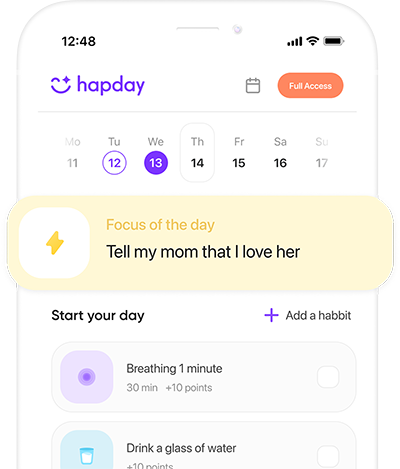
As a practical tool among tools, platforms like Hapday offer 24/7 AI coaching and guided breathing you can use right after a tough session—no scheduling, just a quick regroup so you don’t carry one hour into the next. I’m biased toward anything that reduces friction.
Boundaries make practice effective
- Create a literal closing ritual after the last session: two minutes of breathing, then power down your EHR and office lights in a set order. Rituals cue the brain that duty has ended.
- Batch administrative work and defend one meeting-free block each week. Even small bumps in autonomy reduce burnout risk.
- Practice “compassion with edges”: care for clients without self-neglect. In your sit, visualize a permeable boundary—care flows out; you remain intact. Boundaries are an ethical stance, not a wall.
Between-session micro-practices
- One-minute sensory reset: Name five things you see, four you feel, three you hear, two you smell, one you taste. Grounding blunts rumination carryover.
- Walk the hallway mindfully: 20 steps, heel-to-toe, sensing foot pressure. Movement interrupts sympathetic overdrive and clears cognitive fog.
- Hand-on-heart breath: Six slow breaths to cue parasympathetic tone before feedback calls. Over time, these reps make meditation for therapist burnout second nature. It’s brief, and it works.
Track what changes to prevent relapse
- Pick two metrics: sleep quality (0–10) and end-of-day depletion (0–10). Log them in 30 seconds. Data guides, shame does not.
- Expect a habit curve: Research suggests about 66 days on average to reach automaticity; missing a day doesn’t reset progress. The Guardian once called this “slow magic”—a fair description.
- Review every two weeks: Which practice, time, or place had the biggest payoff? Keep what works, drop the rest. Sustainable meditation for therapist burnout is personalized, not perfect. I’d choose “good enough daily” over “ideal someday.”
Troubleshooting common snags
- “I just rehash sessions when I sit.” Narrow the anchor (breath at the tip of the nose) and use a simple tag—“thinking”—without replaying content.
- “I get sleepy.” Do five minutes of standing practice or mindful walking first; then sit. Light and posture matter more then we think.
- “No time.” Trade one scroll break for a three-minute practice. Even brief mindfulness at work can reduce exhaustion in measurable ways.
Key takeaway
Steady, targeted practice beats aspirational marathons. Treat meditation like charting—small, daily, non-negotiable—and it pays you back in presence and endurance. Presence is the point.
Summary and next step
Meditation for therapist burnout works because it repairs attention, downshifts stress, and rebuilds self-compassion. Start tiny, pair it with boundaries, and track outcomes. If you want consistent support integrating this, consider a coach. One practical option: Hapday for around-the-clock AI coaching and breathing exercises that help you stick with these practices when the day runs hot.
References
- World Health Organization. Burn-out an “occupational phenomenon.” https://www.who.int/teams/mental-health-and-substance-use/policy-law-rights/mental-health-in-the-workplace/burn-out
- Salyers MP, et al. The relationship between professional burnout and quality of care in mental health services. Psychiatr Serv. 2015;66(1):19–31. https://ps.psychiatryonline.org/doi/10.1176/appi.ps.201400091
- American Psychological Association. Demand for mental health treatment continues to increase, psychologists report. 2022. https://www.apa.org/news/press/releases/2022/11/mental-health-treatment-demand
- Goyal M, et al. Meditation programs for psychological stress and well-being: Systematic review and meta-analysis. JAMA Intern Med. 2014;174(3):357–368. https://jamanetwork.com/journals/jamainternalmedicine/fullarticle/1809754
- Hölzel BK, et al. How does mindfulness meditation work? Perspect Psychol Sci. 2011;6(6):537–559. https://doi.org/10.1177/1745691611419671
- Hülsheger UR, et al. Benefits of mindfulness at work: The role of mindfulness in daily emotional exhaustion. J Appl Psychol. 2013;98(2):310–325. https://doi.org/10.1037/a0031313
- West CP, et al. Interventions to prevent and reduce physician burnout: A systematic review and meta-analysis. Mayo Clin Proc. 2016;91(11):1571–1586. https://www.mayoclinicproceedings.org/article/S0025-6196(16)30305-6/fulltext
- Krasner MS, et al. Association of an educational program in mindful communication with burnout, empathy, and attitudes among physicians. JAMA. 2009;302(12):1284–1293. https://jamanetwork.com/journals/jama/fullarticle/184276
- Lally P, et al. How are habits formed in the real world? Eur J Soc Psychol. 2010;40(6):998–1009. https://onlinelibrary.wiley.com/doi/abs/10.1002/ejsp.674
- Neff KD & Germer CK. A pilot study and randomized controlled trial of the mindful self-compassion program. J Clin Psychol. 2013;69(1):28–44. https://doi.org/10.1002/jclp.21923