



When anxiety spikes, connection can act like a dimmer switch on threat. This guide shows how to use 7 love languages for anxiety so you can turn care into a daily, science-backed regulation plan—for yourself, with a partner, or with close friends. While the “love languages” framework isn’t a clinical treatment, mapping support onto these seven areas can organize what actually calms your nervous system. In plain terms, it gives you a map when your mind wants to bolt. I’d argue that’s the real value here.
Note: This is educational and not a substitute for clinical care.
Image alt: person practicing 7 love languages for anxiety with partner during a quiet evening walk
Table of Contents
- What science says about 7 love languages for anxiety
- How to use 7 love languages for anxiety
- 1) Words of affirmation
- 2) Quality time
- 3) Physical touch
- 4) Acts of service
- 5) Thoughtful gifts
- 6) Shared experiences (play/adventure)
- 7) Digital connection and check-ins
- Build your personal plan with the 7 love languages for anxiety
- Troubleshooting
- Summary
- CTA
- References
What science says about 7 love languages for anxiety
- Social buffering is real: Supportive presence lowers perceived threat and physiological arousal. In a 2006 experiment, partner handholding dampened neural responses to threat (Coan et al., 2006). Warm, responsive touch has also been linked with lower blood pressure and higher oxytocin (Holt-Lunstad et al., 2008). The throughline is simple: calm closeness changes the body, not just the mood. In my view, we underuse this because it looks too ordinary.
- Co-regulation beats white-knuckling: Social baseline theory (Coan & Sbarra, 2015) proposes that we’re wired to offload effort to others; being “with” someone reduces the brain’s energy cost and, by extension, anxiety. During 2020 lockdowns, The Guardian reported surges in neighborhood walks—quiet proof that shared, low-stimulus time steadied people when everything else frayed.
- Words matter: Self-affirmation can buffer threat and help people perform under stress (Cohen & Sherman, 2014). When partners respond in attuned, specific ways, mood and coping improve (Maisel & Gable, 2009). A kind sentence won’t fix a panic wave, but it can give your prefrontal cortex a foothold.
- Breathing and body cues: Slow, paced breathing—especially longer exhales—reduces sympathetic arousal and anxiety (Zaccaro et al., 2018). You can feel this within minutes. It’s not mystical; it’s mechanics.
- Small prosocial acts and gratitude shift state: Acts of kindness reduce avoidance in socially anxious individuals (Trew & Alden, 2015). Gratitude practices predict better well-being and steadier affect (Wood et al., 2010). One Harvard Health brief in 2021 called gratitude “a simple, durable lever,” which sounds right to me.
- Note: Evidence for the original five love languages as a scientific model is mixed (Egbert & Polk, 2006). Still, the component behaviors—touch, time, affirming words, practical help—are well studied. That’s the practical lane for the 7 love languages for anxiety.
How to use 7 love languages for anxiety
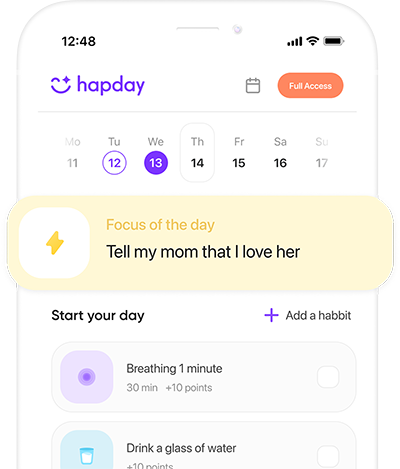
Use this menu to design a plan you can reach for during jitters, spirals, or “I can’t shut my brain off” nights. Some people lean on AI coaching tools like Hapday for 24/7 check-ins, breathing exercises, and progress tracking as an accessible complement to therapy. Personally, I think tools help most when they prompt real-world action, not just more screen time.
1) Words of affirmation
- What to say: “I’m with you; this feeling will pass.” Pair reassurance with reality (“You’ve handled this before”) and specifics (“Let’s breathe for 1 minute, then decide the next step”). Precision beats platitudes.
- Why it helps: Self-affirmation and perceived partner responsiveness reduce stress reactivity and improve coping (Cohen & Sherman, 2014; Maisel & Gable, 2009).
- Self-use: Write a three-line affirmation card you can read when anxious. Within the 7 love languages for anxiety, short scripts prevent blank-mind moments. It’s better to be prepared then to improvise.
2) Quality time
- Co-regulate on purpose: Five to ten minutes of quiet presence, shared breathing, or a low-stimulus walk. Avoid multitasking; soft eye contact and pacing your breath together signal safety. Think “companionable silence,” not problem-solve-at-all-costs.
- Why it helps: Being together lowers the brain’s regulatory “cost” (Coan & Sbarra, 2015). My take: this is the most underestimated tool couples already have.
3) Physical touch
- Fast-acting options: A 20–30 second hug, handholding, or a warm hand on the shoulder paired with a slow exhale. A weighted blanket can mimic firm, steady pressure if you’re solo. Keep it steady, not startling.
- Why it helps: Warm touch is associated with oxytocin increases and reduced cardiovascular reactivity (Holt-Lunstad et al., 2008). Partner handholding decreases neural threat responses (Coan et al., 2006). The body hears safety through skin.
4) Acts of service
- Clear the deck: Anxiety feeds on overload. Ask for—or offer—one concrete task: “I’ll email the landlord,” “I’ll drive you to the appointment,” or “I’ll sit with you while you open the bill.” Narrow the field to one next step.
- Why it helps: Practical support reduces cognitive load, enabling problem-focused coping. Structured action mirrors behavioral activation principles used in anxiety and depression care. In my experience, this is where momentum returns.
5) Thoughtful gifts
- Grounding tokens: Keep a “calm kit”—soothing tea, a tactile stone, lavender sachet, or a printed breathing cue card. Partners can prepare this in advance, the way you’d set out an umbrella before rain.
- Why it helps: Small cues tether you to the present; gratitude for thoughtful gestures correlates with better mood regulation (Wood et al., 2010).
- Note: Music “gifts” (shared playlists) can lower anxiety via autonomic and neurochemical pathways (Chanda & Levitin, 2013). A three-song ritual can be enough.
6) Shared experiences (play/adventure)
- Micro-adventures: A new park loop, a five-minute dance break, or a mini photo-walk. Novelty plus movement disrupts ruminative loops. Keep stakes low, curiosity high.
- Why it helps: Physical activity and enjoyable novelty engage reward circuits and redirect attention; playful co-experiences rebuild safety around bodily sensations. I’m biased, but a brisk evening loop beats another doomscroll.
7) Digital connection and check-ins
- Use your phone wisely: Create a “green dot” system—send a single green dot when you’re okay after a spike, yellow for “check on me tonight,” red for “call now.” For self-use, text yourself a three-line log: trigger, feeling, one next step. Predictable signals trump vague worry.
- Why it helps: Quick, reliable support lowers uncertainty; even brief expressive writing shows small-to-moderate mental health benefits (Frattaroli, 2006). Social support reliably buffers stress (Uchino, 2006). It’s not the phone—it’s the pattern you build with it.
Build your personal plan with the 7 love languages for anxiety
- Pick your top two. Start where relief is fastest (e.g., touch + quality time). Favor what you’ll actually use.
- Script it. Draft two affirmation lines and one “act of service” you’ll request. Put them where your future self can find them.
- Set cues. Place your calm kit by the bed; schedule a nightly 10-minute co-regulation walk. Routines do the heavy lifting.
- Track patterns. Note which languages quiet spirals most quickly; adjust. Data, but humane—weekly notes are enough. My bias: less tracking, more repeating what works.
Troubleshooting
- If words backfire: Shift to sensory first (touch, breath), then revisit language. Physiology before philosophy.
- If your partner is unsure what to do: Share a one-page “owner’s manual” listing your top 3 helps and 3 triggers, plus the stepwise plan. Clarity reduces guesswork—and resentment.
- If you’re solo: Pair self-affirmations with paced breathing (inhale 4, exhale 6 for 3 minutes), then a small act of service for future-you (prep breakfast). Keep it simple; consistency beats intensity.
Summary
Anxiety shrinks when support is structured. The 7 love languages for anxiety map proven calming behaviors—affirming words, time, touch, service, gifts, shared experiences, and steady check-ins—onto an easy playbook you can personalize. Start with two, script them, and practice in calm moments so they’re ready under pressure. Bold, small steps count.
CTA
Choose your top two love languages today, write one concrete action for each, and schedule a 10-minute practice session this week.
References
- Coan, J. A., Schaefer, H. S., & Davidson, R. J. (2006). Lending a hand: social regulation of the neural response to threat. Psychological Science. https://doi.org/10.1111/j.1467-9280.2006.01730.x
- Holt-Lunstad, J., Birmingham, W., & Light, K. C. (2008). Influence of a “warm touch” support enhancement intervention among married couples. Journal of Behavioral Medicine. https://link.springer.com/article/10.1007/s10865-008-9152-4
- Coan, J. A., & Sbarra, D. A. (2015). Social baseline theory. Current Opinion in Psychology. https://www.sciencedirect.com/science/article/pii/S2352250X15000399
- Maisel, N. C., & Gable, S. L. (2009). The paradox of received social support. Journal of Personality and Social Psychology. https://doi.org/10.1037/a0017029
- Cohen, G. L., & Sherman, D. K. (2014). The psychology of change. Annual Review of Psychology. https://doi.org/10.1146/annurev-psych-010213-115137
- Zaccaro, A., et al. (2018). How breath-control can change your life. Frontiers in Human Neuroscience. https://www.frontiersin.org/articles/10.3389/fnhum.2018.00353/full
- Trew, J. L., & Alden, L. E. (2015). Kindness reduces avoidance goals in social anxiety. Motivation and Emotion. https://link.springer.com/article/10.1007/s11031-015-9503-7
- Wood, A. M., Froh, J. J., & Geraghty, A. W. (2010). Gratitude and well-being. Social and Personality Psychology Compass. https://doi.org/10.1111/j.1751-9004.2010.00305.x
- Chanda, M. L., & Levitin, D. J. (2013). The neurochemistry of music. Trends in Cognitive Sciences. https://doi.org/10.1016/j.tics.2013.06.003
- Frattaroli, J. (2006). Experimental disclosure and its moderators. Psychological Bulletin. https://pubmed.ncbi.nlm.nih.gov/16822164/
- Egbert, N., & Polk, D. (2006). Speaking the language of relational maintenance: A validity test of Chapman’s five love languages. Communication Research Reports. https://www.tandfonline.com/doi/abs/10.1080/17464090500535822
- Uchino, B. N. (2006). Social support and health. Journal of Behavioral Medicine. https://link.springer.com/article/10.1007/s10865-006-9056-5