

Table of Contents
- Diving Into Guilt’s Origins
- The Body’s Reaction to Guilt
- The Trap of Self-Blame
- Practical Remedies for Guilt’s Cycle
- The Tyranny of Perfectionism
- Tackling Perfectionist Tendencies
- Saying “No” and Building Boundaries
- Forgiveness: The Path Forward
- Envisioning a Guilt-Free Tomorrow
- References
Key Takeaways
- Understanding the origins of guilt can help us navigate our emotions.
- Self-blame perpetuates guilt; shifting our perspective can lead to growth.
- Setting boundaries and practicing self-forgiveness are crucial steps in overcoming guilt.
- Mindfulness and self-compassion can foster resilience against feelings of guilt.
- Transforming guilt into a tool for introspection can lead to a guilt-free life.
Late one evening, with a soft glow from the laptop illuminating her face, Emily found herself staring defeatedly at an email she’d been avoiding for weeks. Sound familiar? Guilt, that relentless adversary, has been there for all of us—whether from missed opportunities, broken promises, or choices that went a bit off course. Yet, what if today is the day to shatter those shackles?
Diving Into Guilt’s Origins
Guilt. We all know it, yet where does it spring from? Dr. Sarah Chen, clinical psychologist at NYU, describes guilt as a response when our behavior clashes with internal standards. It’s like our personal alarm system for ethics. But, sometimes, the alarm never stops blaring—it gets loud and, frankly, unbearable.
Back in 2021, the American Psychological Association highlighted how moderate guilt can be motivating, but chronic guilt? That’s a recipe for anxiety or even depression. When Maya—a 28-year-old navigating life post-divorce—felt overwhelmed by guilt for “disrupting” her family, it lingered until she accepted her emotions as part of processing the change.
The Body’s Reaction to Guilt
Recently, research in Nature Reviews Neuroscience pointed out the role of the brain’s prefrontal cortex in producing feelings of guilt. When guilt hits overload? Decisions and emotions go haywire; it’s a bit like a car engine misfiring. While the science might seem heavy, understanding it helps in mending the emotional wounds guilt can inflict.
The Trap of Self-Blame
Have you ever mulled over past errors, feeling the sting of self-blame?
“Self-blame builds because people often think they alone are the cause of every mishap.”
— Dr. Robert Landy, Therapist and Author
This mindset keeps us spinning in endless guilt.
Cognitive Behavioral Therapy (CBT) advocates for a shift in perspective: learn from missteps rather than dwelling on them. Take Emily, for example—upon reviewing that looming email, she saw it as more than just procrastination; it was an opportunity for growth.
Practical Remedies for Guilt’s Cycle
Journaling might be your golden ticket. Put it all down—your feelings, your thoughts—and reflect without diving into despair. It’s like clearing foggy glasses; suddenly, everything’s clearer.
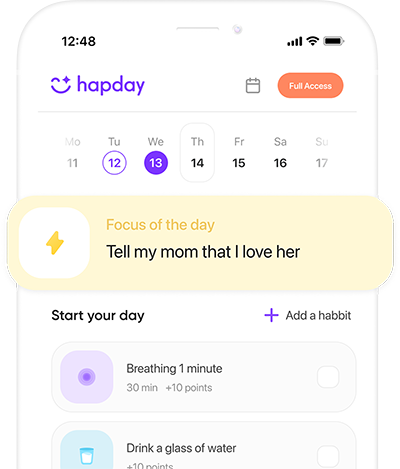
Tools like Hapday could be your midnight savior. Imagine it’s 2 a.m., your thoughts are racing, and traditional counseling’s not an option—Hapday’s AI coaching could offer instant relief.
The Tyranny of Perfectionism
Perfectionism creates an imposing fortress around guilt. While ambition pushes us forward, unattainable standards bring misery.
Consider Jenna, a graphic designer whose self-worth was bound to flawless projects. When reality fell short of perfection? Guilt washed over, overshadowing her wins.
“Redefining what’s ‘perfect’ is essential to break these chains.”
— Dr. Anna Smith, Cognitive Psychologist
Tackling Perfectionist Tendencies
Recognize the line between ambitious targets and unhealthy perfectionism. It’s about improvement, not evading failure.
Self-compassion is a worthy ally here. Researcher Kristin Neff at the University of Texas found that self-kindness fosters resilience. Mistakes are part of being human, after all.
Try meditation or mindfulness to ground your thoughts. Apps akin to Hapday can support this journey, providing exercises to calm a whirlwind mind.
Saying “No” and Building Boundaries
Creating boundaries and the art of saying “no” can be guilt’s antidote. Many, particularly women, struggle with this, fearing they’re letting others down—a guilt spiral ensues.
Young professional Jessica used to find herself torn between her own aims and external pulls. Freeing herself began with setting boundaries for her emotional health. Sure, it’s tough initially, but it’s transformative.
Forgiveness: The Path Forward
Forgiveness, especially self-forgiveness, offers a powerful route out of guilt.
“Forgiving oneself is not about ducking responsibility but recognizing imperfection.”
— Dr. Michele Martin, Expert in Forgiveness Therapies
Take Daniel. He carried guilt over a fractured family relationship, unresolved for years. Self-forgiveness finally allowed him to move from a place of guilt to one of agency.
Envisioning a Guilt-Free Tomorrow
Breaking free from guilt isn’t about reckless abandon. It’s about letting guilt guide you, not imprison you. Take Maya’s post-divorce guilt; by reframing it, she turned a heavy burden into a moment of introspection.
Ground yourself in today’s joys with mindfulness, savor the present’s simplicity.
If you’re ready for real change, try Hapday’s supportive 24/7 programs—they could help you, and millions like you, break into a life untethered by guilt.
Consciously confronting guilt allows us to embrace imperfection, enrich our inner dialogue, and strive towards authentic, presently grounded lives. Who knows what we—freed from guilt’s grip—might achieve?
The Bottom Line
Breaking free from guilt involves understanding its roots, transforming our perspectives, and practicing self-compassion. By forging boundaries and embracing forgiveness, we can journey towards a guilt-free existence and achieve personal growth.
References
- American Psychological Association
- Nature Reviews Neuroscience
- University of Texas Research on Self-Compassion
- Insights from Dr. Sarah Chen, Dr. Robert Landy, Dr. Anna Smith, Dr. Michele Martin