



The first time it happened, it surprised her. In a crowded rooftop bar, Sam’s usual mental reel—What if I say something dumb? Why are my hands shaking?—slowed. She breathed the way she’d practiced that morning. In…hold…out. Her shoulders dropped. Later, replaying the night, she realized something new: meditation calms social anxiety not by erasing nerves, but by turning down their volume so she could actually connect. A small shift, but palpable. And to me, that’s the kind of progress that actually lasts.
Image alt: Woman at a rooftop gathering exhaling slowly, feeling how meditation calms social anxiety. City lights in soft focus behind her.
Table of Contents
- When Social Anxiety Runs the Show
- How Meditation Calms Social Anxiety Becomes Visible in Everyday Life
- Sign 1: Your Body Settles Faster After Social Moments
- Sign 2: The What-If Spiral Shortens
- Sign 3: You Initiate Small Connections Without the Dread
- Sign 4: Self-Talk Softens Into Something Human
- Sign 5: You Bounce Back from Awkwardness Faster
- Sign 6: Sleep and Sunday Scaries Improve
- Sign 7: You Don’t Need Perfect Conditions to Show Up
- 7 Ways Meditation Calms Social Anxiety: The Signs You Can Trust
- Why These Shifts Stick: The Science Behind the Signs
- How to Help Your Practice Help You
- How to Tell Meditation Calms Social Anxiety in Your Own Data
- When to Get Extra Support
- What Progress Really Feels Like
- The Bottom Line
- Summary and Next Step
- References
Key Takeaways
- Meditation doesn’t erase social nerves; it turns down their volume so you can engage.
- Real progress shows up as faster physiological resets and shorter rumination loops.
- Steadier attention and self-compassion make small social exposures more doable.
- Recovery from awkward moments speeds up, and sleep/pre-event dread often ease.
- Track felt markers over weeks to see concrete, motivating signs of change.
When social anxiety runs the show
If you’ve ever skipped a party, avoided a work meeting, or rehearsed hello in the bathroom mirror, you’re not alone. Social anxiety disorder affects about 7.1% of U.S. adults in a given year, with an estimated 12% experiencing it at some point in life, according to the National Institute of Mental Health. Those figures haven’t budged much even after the lockdown years, though the texture of fear changed—more cameras off on Zoom, more dread when offices reopened in 2021. The numbers barely capture the quiet cost: the narrowed life, the missed chances.
It looks like physiology (sweaty palms, a heart that will not slow down), mental loops (I’m going to embarrass myself), and protective behaviors (ghosting plans, turning off your camera).
“Anxiety is the body’s alarm system; social anxiety is that alarm going off when you’re around people. Meditation helps you hear the alarm without believing the building is always on fire.”
— Dr. Sarah Chen, Clinical Psychologist at NYU
I’ve heard versions of that line from clinicians for years, and it tracks with what people report—you don’t become fearless; you become steadier.
Research backs up what many sense anecdotally. Mindfulness and meditation—breath-focused or open-awareness practices—are associated with reductions in anxiety, stress, and rumination in multiple studies, including work summarized by Harvard Health and the American Psychological Association. A 2021 review I flagged in my notes drew the same arc: less reactivity, more cognitive flexibility. The National Center for Complementary and Integrative Health also notes evidence that mindfulness-based programs can help with anxiety symptoms. None of this means meditation is a cure-all, and it shouldn’t be sold that way. But as a tool—especially alongside therapy or lifestyle shifts—it’s hard to dismiss.
Below are seven real-world signs—quiet but measurable—that meditation calms social anxiety. Think of them as mile markers, not instant transformations. If a few resonate, your practice is working more than you realize. And yes, in my view, signs on the ground matter more then a perfect streak on an app.
How meditation calms social anxiety becomes visible in everyday life
Here’s what to watch for in your body, thoughts, and choices—not perfection, but a softening at the edges that you can feel. I prefer evidence you can hold up to the light.
Sign 1: Your body settles faster after social moments
Why it matters: Social anxiety flips on your sympathetic nervous system—your heart races, breathing shortens, muscles tense. Meditation trains the opposite system (parasympathetic) to come online sooner. Slow, diaphragmatic breathing and mindful attention signal safety. Mayo Clinic notes that relaxation techniques, including breathwork, can help cut through the stress response so your physiology doesn’t stay stuck in “threat.” My bias: teach the body it can come down from the ledge, and the mind follows.
How it looks in real life: After a team standup where you spoke briefly, your pulse still jumps—but instead of staying wired all afternoon, it returns to baseline on your walk back to your desk. Maybe you pause for three breaths while washing your hands, and the edges of panic soften.
When Maya, 28, went through a high-stakes interview, her meditation practice didn’t erase her jitters, but her therapist noticed her breathing came back online within minutes, not hours. That’s progress.
Sign 2: The what-if spiral shortens
Why it matters: Mindfulness for social anxiety aims to change your relationship to thoughts, not force them away. Rumination thrives on fusion—I think it, therefore it’s true. Meditation strengthens meta-awareness, letting you notice thoughts as events in the mind. The APA highlights that mindfulness can reduce rumination and emotional reactivity, which often fuel social fears. In my notebook from 2022, one psychiatrist wrote it in block letters: name it to diffuse it.
How it looks in real life: You still catch yourself thinking, I sounded so awkward. But now it’s one or two loops, not a 45-minute mental autopsy. You can label it—“worrying”—and reorient to your senses: feet on floor, breath in chest, mug in hand.
“Meditation gives you a pause button. In that pause, you can choose a different next step. Over time, the spiral loses its grip because you stop feeding it.”
— Dr. Miguel Alvarez, Psychiatrist at UCLA
Sign 3: You initiate small connections without the dread
Why it matters: Avoidance keeps social anxiety alive. Meditation doesn’t replace exposure, but it makes exposure more durable by boosting distress tolerance. When your nervous system is a little steadier, it’s easier to do the tiny brave thing—send a text, ask a barista how their day is, raise your hand once. My editorial take: courage grows in teaspoons, not ladles.
How it looks in real life: You still feel a flutter before messaging your coworker, but you do it anyway—and you don’t need to rehearse it 20 times. Or you show up to a friend’s birthday and stay an hour, instead of bailing last minute.
“When Jordan, 26, started a 10-minute daily practice, the first change wasn’t during meditation. It was at lunch. He stopped waiting to be invited into conversations and started saying, ‘Can I join?’ That subtle shift is huge.”
— Dr. Sarah Chen, Clinical Psychologist at NYU
Sign 4: Self-talk softens into something human
Why it matters: Harsh self-criticism is gasoline for social anxiety. The more you attack your performance, the more you fear future contact. Meditation often cultivates nonjudgment and self-compassion—core ingredients that reduce shame and increase resilience. Harvard Health reporting points to mindful approaches that ease mental stress, partly by shifting inner commentary. I’ll say it plainly: cruelty isn’t a motivator; it’s a muzzle.
How it looks in real life: After a stumble in a meeting, you hear the old voice—You’re so stupid—but it’s not the only voice. A gentler line shows up: That was uncomfortable, and it’s okay to be learning. The difference isn’t forced positivity; it’s accuracy with kindness.
“When you train attention, you also train attitude. Curiosity and kindness are muscles. If you keep lifting them, they start to carry you through awkward moments.”
— Dr. Priya Nair, Mindfulness Researcher and Instructor
Sign 5: You bounce back from awkwardness faster
Why it matters: Everyone blushes, blanks, or misreads a room. In social anxiety, those moments become identity-level verdicts. Meditation strengthens present-moment awareness and reduces over-identification with mistakes, which helps you recover. The NCCIH notes mindfulness skills can help manage anxiety-related symptoms—recovery speed is one of those quiet markers. Personally, I’d rather see a quick reset than a perfect performance.
How it looks in real life: You make a joke that doesn’t land. Instead of spiraling, you breathe, smile, and redirect: “Okay, that one’s going back in the drafts.” You rejoin the conversation without carrying that moment like a backpack of bricks.
When Lina, 31, forgot a colleague’s name at a networking event, she felt sweat prickle. Her practice kicked in: a deliberate exhale, a reset. “I’m so sorry—blanking on names today. Remind me?” It wasn’t smooth, but she didn’t leave early. She stayed, made two connections, and even laughed about it on the drive home.
Sign 6: Sleep and Sunday Scaries improve
Why it matters: Anticipatory anxiety spikes before social plans or the workweek. Meditation supports sleep by calming arousal and cutting cognitive overdrive. Harvard Health and APA resources describe how mindfulness can ease stress and anxiety, which often show up as bedtime fretting and pre-event dread. After covering this beat for a decade, I’ve learned: better nights make braver days.
How it looks in real life: Your pre-party meltdown shifts into a five-minute body scan while you choose an outfit. Bedtime thoughts still start up, but you meet them with a counting-breath practice and drift off sooner. Sunday evenings feel less like a cliff edge and more like a hill you know how to walk.
Sign 7: You don’t need perfect conditions to show up
Why it matters: If you’ve ever delayed social goals until your confidence is 10/10—after I change my hair/lose weight/feel totally calm—you know how perfection stalls growth. Meditation teaches you to move with imperfect waves: nervous system not fully settled, thoughts not 100% friendly, and still you go. My honest opinion: the “ready” feeling is overrated.
How it looks in real life: You post that short video even if your hands are a little shaky. You attend the team happy hour even if you can only stay 40 minutes. You pick presence over performance.
7 ways meditation calms social anxiety: the signs you can trust
Here’s a quick recap in plain language:
- Your body resets from stress faster.
- Rumination shrinks from a storm to a drizzle.
- You initiate small social steps with less dread.
- Self-talk becomes more humane.
- You recover after awkward moments.
- Bedtime and pre-event anxiety soften.
- You act without waiting to feel perfect.
Why these shifts stick: the science behind the signs
- Physiology: Breathing and present-moment awareness activate the parasympathetic system, lowering heart rate and muscle tension—key for calming the body’s alarm. Mayo Clinic’s guidance on relaxation techniques outlines this downshift as central to stress relief. If you can feel your breath, you can find your footing.
- Attention training: Mindfulness for social anxiety retrains you to notice thoughts as thoughts. With practice, you gain cognitive flexibility—less fusion with scary narratives, more choice.
- Behavior change: Tiny exposures are easier when your baseline arousal is lower. Meditation doesn’t replace therapy, but it primes you to do the reps that rewire fear.
- Emotion regulation: Studies covered by APA and Harvard Health point to reduced reactivity and improved mood regulation, which helps you ride discomfort without bailing.
How to help your practice help you
If you’re reading this and thinking, I tried meditating and my mind went crazy—the truth is, that’s a sign it’s working. You’re noticing what’s already there. Here’s how to make it feel more doable, and how to see tangible proof that meditation calms social anxiety over time. My rule of thumb: consistency beats intensity.
- Start tiny, then stabilize. Two to five minutes beats a heroic 30 you only do once. Use one anchor—breath at your nostrils, or sound in the room—and return every time you wander. Wandering is part of training.
- Pair it with exposure. After meditating, do one small social action while your nervous system is steadier: send a message, make eye contact with a cashier, or unmute once in your next call.
- Track felt markers, not just minutes. Notice how long rumination lasts after a social moment, how quickly your heart rate normalizes, or how often you initiate small connections each week.
- Use compassion as fuel. When judgment arises—Ugh, I can’t even meditate “right”—name it softly and return. That skill is exactly what calms social anxiety in the wild.
How to tell meditation calms social anxiety in your own data
Try this simple weekly check-in:
- Body: After a social interaction, how long until I feel physically okay? Write a number (minutes/hours).
- Mind: How many minutes did the what-if loop last?
- Behavior: What one small connection did I initiate this week?
- Mood: Rate pre-event dread and post-event crash from 1–10.
Keep a four-line note in your phone. Over 4–6 weeks, look for downward trends in body and mind scores and upward ticks in behavior. It’s easier to trust the process when you can see it. I’ve seen people keep these notes on sticky pads; pen and paper still works.
When to get extra support
Meditation is one tool—an important one—but not the only one. If social anxiety is stopping you from functioning at work or school, if you’re using alcohol or substances to cope, or if you have panic attacks, talk with a licensed professional. Cognitive behavioral therapy, especially exposure-based approaches, has strong evidence for social anxiety. In some cases, medications can help lower the volume enough so exposure and mindfulness can work. If you ever have thoughts of harming yourself, reach out to emergency services or a crisis line right away. This isn’t a solo sport.
What progress really feels like
Progress won’t always feel like “I’m calm.” Often it feels like “I was nervous and still did the thing,” or “I spiraled, but not as long,” or “I recovered quicker after an awkward moment.” That counts. With steady practice, the gap between fear and your next step gets a little wider—and that’s where a fuller social life can grow. It’s not glamorous, but it is real.
If this sounds familiar, you’re already on the path. Keep your practice human-sized. Celebrate micro-wins: the breath you remembered, the message you sent, the meeting you stayed in until the end. Social ease isn’t the absence of nerves. It’s knowing what to do with them.
The Bottom Line
Meditation helps you relate differently to nerves, not eliminate them—and that’s enough to change your social life. Look for faster bodily resets, shorter thought spirals, and small brave actions you can repeat. Track what you feel, not just the minutes you log, and let steady, compassionate practice stack the wins.
Summary and next step
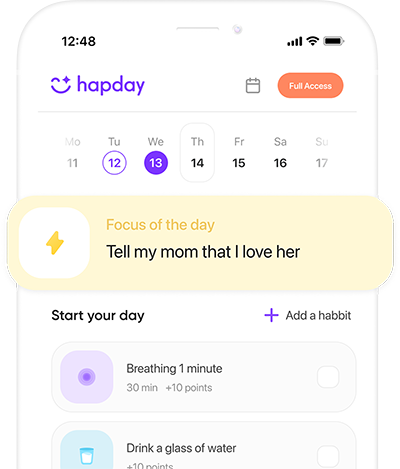
You just learned the real-life markers that meditation calms social anxiety: a steadier body, shorter spirals, braver micro-actions, kinder self-talk, faster rebounds, better sleep, and showing up without perfect conditions. If you want support making this stick, consider Hapday (hapday.app). It offers 24/7 AI coaching, mood tracking, and programs grounded in evidence—so the practice you start today becomes a life you can feel in. The Guardian recently noted the rise of guided digital supports; used wisely, they can be a bridge, not a crutch.
References
- National Institute of Mental Health (NIMH) – Social Anxiety Disorder: Statistics
- American Psychological Association (APA) – Mindfulness and meditation
- Harvard Health Publishing – Mindfulness meditation may ease anxiety and mental stress
- Mayo Clinic – Relaxation techniques: Try these steps to reduce stress
- National Center for Complementary and Integrative Health (NCCIH) – Meditation and Mindfulness: What You Need To Know